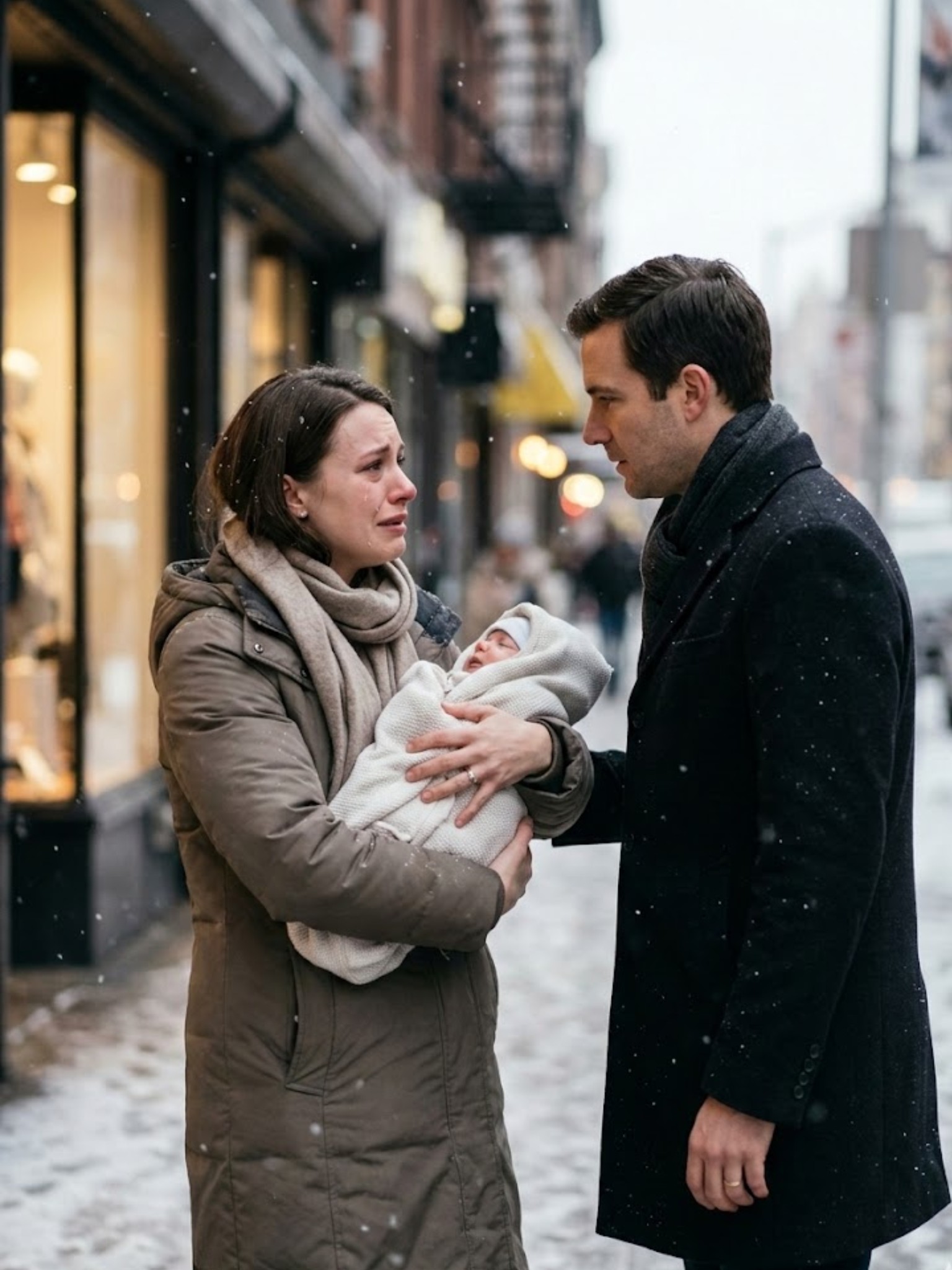
Part 1 — A Box of Milk in a City of Glass
Winter in Boston had a way of swallowing sound.
Snow didn’t just fall there—it settled. It packed itself into the seams of the city and muted everything it touched. Cars moved like they were afraid to make noise. Footsteps softened into a dull crunch. Even the harbor wind seemed to arrive with intention, slipping between buildings and cutting straight through wool, straight through bone, like the city wanted to remind you who was really in charge.
Andrew Keller stepped out of a glass-front café on Boylston with his phone in hand and his mind already three steps ahead of his body.
He was used to being ahead.

His world ran on precision—on schedules, on margins, on decisions that didn’t wait for feelings. He had built Keller Technologies the way you build a machine: part by part, screw by screw, making sure every piece obeyed. He was the kind of founder people called “visionary” when they wanted to sound kind, and “cold” when they didn’t.
No interruptions.
No surprises.
No time wasted on things that didn’t scale.
Andrew tucked his phone against his palm and started walking, collar up, shoulders braced against the wind that came off the harbor like it had teeth.
He was halfway down the block when a voice broke through the cold.
“Sir, please.”
It wasn’t loud.
It wasn’t theatrical.
It was small and steady—like the person speaking had learned long ago that shouting only made adults look away faster.
Andrew slowed and turned.
A girl stood near the curb, partially sheltered by a streetlight pole. Her hair was tangled by the wind, and her coat—an old wool thing that might’ve once belonged to an adult man—hung several sizes too big, swallowing her frame. The sleeves hid most of her hands. Her cheeks were red from cold, not rosy—raw.
In her arms she carried a small bundle wrapped in a blanket so thin it barely held together. The blanket had holes, and through one of them Andrew caught a glimpse of tiny fingers, curled and stiff.
The girl shifted the bundle closer to her chest as if trying to share her body heat with whatever she was holding.
“My brother’s hungry,” she said softly.
Andrew’s eyes flicked to the bundle.
A baby.
Maybe a toddler, but small enough that it could’ve gone either way.
The girl looked up, and there was nothing childish in her expression. No whining. No exaggerated desperation. Just exhaustion and the kind of determination that doesn’t belong to ten-year-olds.
“Just one box of milk,” she said. “I’ll pay you back when I grow up.”
People walked past them like the girl was part of the scenery.
A couple in scarves stepped around her without breaking stride. A man in a long coat glanced once and then stared hard at his phone like it was suddenly the most interesting thing in the world. Someone laughed on the other side of the street, bright and careless, and the sound felt wrong in the cold air.
Andrew’s first instinct was to move on.
He felt it in his body like a reflex—the urge to step back into his lane, back into the world where problems had solutions and solutions had price tags and you didn’t get pulled into random suffering on a sidewalk.
He’d learned early that if you stopped for every tragedy, you’d never move at all.
That was what he told himself.
But something in the girl’s tone stopped him.
Not desperation.
Not manipulation.
Just… calm.
Like she’d accepted how the world worked and was asking anyway.
Andrew stared at her for a long moment, and in that pause he felt something uncomfortable rise in his chest.
Not guilt exactly.
Recognition.
Because he knew that kind of calm.
He’d worn it himself once, back when he was broke and young and building his first prototypes in a tiny apartment, back when he’d been hungry in ways he didn’t talk about now.
“What’s your name?” he asked.
The girl hesitated, as if names were dangerous to give away.
“Ruth,” she said finally, eyes down. “And this is Samuel.”
Andrew looked at the bundle again. The blanket moved slightly, a tiny breath pushing against thin fabric.
“Samuel,” Andrew repeated under his breath, as if saying it made the baby more real.
He nodded toward the corner store across the street.
“Come on,” he said.
Ruth didn’t move right away. She watched him carefully, like she’d learned to read adults the way you read weather—looking for signs of danger.
Andrew waited.
He didn’t reach for her.
He didn’t rush her.
After a beat, Ruth shifted Samuel higher in her arms and followed, careful steps on slick sidewalk.
They crossed at the light. Andrew stood between her and the street automatically, not as a gesture, just instinct. The wind hit harder in the open intersection, and Ruth curled her shoulders tighter around the baby.
The corner store’s bell jingled when they stepped inside.
Bright lights.
Warm air.
Christmas music playing too cheerfully for late January, the kind of song that made hunger feel even sharper because it reminded you what other people had.
Andrew grabbed a basket and moved through the aisles like he’d done it a thousand times.
Milk first.
Then bread.
Then peanut butter, because it lasted.
Then a small box of cereal.
Then a pack of diapers without even asking because he’d seen enough to know what a thin blanket meant.
Ruth trailed behind him, silent, eyes wide. She wasn’t the kind of kid who grabbed for candy or begged for extras. She looked like she didn’t trust abundance.
As Andrew turned down the last aisle, something caught his eye—a small stuffed bear hanging from a rack, cheap, soft, the kind of thing parents bought to make a kid smile in a checkout line.
He grabbed it too.
Ruth didn’t say anything, but her fingers tightened on Samuel’s blanket as she watched.
At the register, the cashier gave Andrew a curious look—recognition, maybe. Andrew Keller wasn’t invisible in Boston. Not with his name on buildings and headlines.
But Andrew didn’t care about recognition in that moment.
He paid, then crouched slightly so he could help Ruth repack her worn canvas bag. The bag was older than she was, stained and frayed at the seams, but she handled it with care like it was her whole life.
Andrew placed the milk and bread carefully, then handed her the bear.
Ruth stared at it like she didn’t know what to do with something that wasn’t purely survival.
“It’s for him,” Andrew said quietly. “Or for you. Whoever needs it more.”
Ruth’s eyes glassed over, but she refused to let tears fall. She blinked hard and looked away like emotion was a weakness she couldn’t afford.
“You don’t owe me anything,” Andrew said.
Ruth’s head snapped up slightly, like she’d expected him to demand something in return.
Andrew kept his voice low, steady.
“Just take care of him,” he said. “That’s all I ask.”
For a second, Ruth didn’t move at all.
Then she whispered, barely audible, “Thank you, Mr…”
“Keller,” Andrew said. “Andrew Keller.”
Ruth mouthed the name like she was filing it away somewhere safe.
“Andrew Keller,” she repeated softly, like a vow.
Then she turned, clutching Samuel and the bag, and walked out into the snow.
Andrew watched her disappear into the white glare of winter, the canvas bag bumping against her hip, the oversized coat fluttering around her legs like it might carry her away.
When the bell jingled again and the door closed, the store felt warmer and emptier at the same time.
Andrew stood there a moment longer than he meant to.
Then he left.
That night, Andrew sat by the window in his office.
His penthouse wasn’t loud, but it was never truly quiet either. There was always the distant hum of the city, always the glow of traffic far below, always the faint vibration of money moving through the world like blood through veins.
He’d closed billion-dollar deals without blinking.
He’d signed away companies like they were line items.
But he couldn’t shake the image of a small girl walking into a storm with a baby in her arms, asking for milk like it was the only thing standing between them and something worse.
Two days later, Andrew did something he almost didn’t do.
He asked his assistant to reach out to local shelters.
He didn’t tell himself it was obsession.
He told himself it was due diligence. A loose end. Something he needed to close so he could stop thinking about it.
But his assistant came back with nothing.
No one had seen a girl named Ruth.
No one had seen a baby named Samuel.
No intake record. No report.
She had vanished as quickly as she appeared.
And that—more than anything—stayed with him.
Because it suggested a truth Andrew didn’t like admitting:
Some people could disappear in this city and nobody would notice.
Not unless someone decided to stop.
Years moved on.
Andrew grew older, richer, lonelier.
He began funding scholarships, hospitals, community centers. He wrote checks the way other men wrote apologies. He did good things in big, measurable ways.
But still, something in him felt unfinished.
Not guilty.
Not even regretful.
Just… incomplete.
Like there was a piece of his life still standing on a frozen sidewalk, staring at a girl who asked for milk and gave him back a feeling he hadn’t expected:
Humanity.
Part 2 — The Name That Came Back
Years have a way of smoothing out sharp memories.
Not erasing them—just dulling the edges so you can carry them without cutting yourself every time you touch them. For Andrew Keller, time did what it always did: it filled the calendar. It piled on meetings, acquisitions, keynote speeches, and the endless hum of “what’s next” until even the things that mattered got pushed into the corners of his mind.
But the image of Ruth never fully left.
It would come back at odd moments—when he saw a child’s mitten dropped on a subway stair, when he heard a baby cry on a sidewalk, when winter wind hit him just right and suddenly he was back outside that corner store watching a girl vanish into snow with a bag of milk and a stuffed bear.
Andrew tried to outrun it.
He did what powerful men did when something unsettled them: he made it part of a system.
He funded scholarships.
He wrote checks to hospitals.
He built community centers with his name on the front so the giving could feel organized, official—something that fit into the language he knew best.
But no matter how much he gave, it never quite closed the loop.
Because giving in bulk was not the same as stopping for one child in the cold.
Bulk giving could be delegated.
That moment couldn’t.
Two days after the café encounter, when he’d asked his assistant to contact shelters and got nothing back, Andrew told himself it was over.
Maybe Ruth had found help.
Maybe someone else had stepped in after him.
Maybe she had relatives.
Maybe she’d never been real at all—just a fleeting blur of winter that his mind had turned into meaning because he’d needed something to feel.
But deep down, he knew better.
You don’t invent the look Ruth had in her eyes.
You don’t imagine the way Samuel’s tiny fingers curled stiff in that thin blanket.
Those were real.
And the fact that no one could find them meant the city had swallowed them whole.
That fact—quiet, brutal—changed Andrew more than he ever admitted.
He got older.
He got richer.
He got quieter.
And the empire he built—Keller Technologies—grew so massive it became a thing separate from him, a machine that ran even when he slept. People treated him like he was untouchable. Like his life was made of a different substance than theirs.
Andrew let them.
Not because he believed it.
Because it was easier than explaining that at night, in the stillness of glass and steel, he sometimes felt like the loneliest man in Boston.
There were women, yes.
There were invitations and parties and social calendars full enough to suffocate.
But Andrew never quite belonged anywhere that wasn’t a boardroom.
And in the rare quiet moments, when the phone stopped ringing, the question came back:
What happened to Ruth?
It was a gray morning in late winter when his secretary knocked on his office door.
Andrew was already on his second cup of coffee, eyes on a contract draft, mind working the way it always worked—fast, focused, impatient.
“Mr. Keller,” she said carefully, as if she didn’t want to disturb the wrong kind of mood. “There’s a Dr. Ruth Sanderson here to see you.”
Andrew didn’t look up at first.
“I don’t know that name,” he said, already reaching for the next page. “Send her in.”
The door opened.
Andrew finally lifted his eyes.
And for a second, his brain misfired.
The woman who entered stood tall, her posture calm and self-assured. She held her white coat folded over her arm, and she moved with the steady confidence of someone used to being responsible for life. Her hair was tied neatly back. Her face was composed.
But her eyes—
Her eyes carried something that hit Andrew like a sudden gust of cold air.
Recognition.
Not celebrity recognition.
Not the kind that comes with seeing someone on magazine covers.
Personal recognition.
The kind that means a person remembers you from a moment that mattered.
“Mr. Keller,” she said, extending a hand. “You might not remember me, but when I was ten years old, you bought me a box of milk.”
Andrew’s breath caught.
The office around him—glass walls, skyline, polished wood—blurred for a moment. Memory surged forward like a photograph pulled from fog.
Snow.
A streetlight.
A too-big coat.
A baby in a thin blanket.
A steady voice asking for milk like it was a promise.
“Ruth,” Andrew whispered before he even realized he’d said it.
The woman’s mouth softened into a faint smile.
“The girl from the street,” Andrew added, voice rougher now.
“Yes,” she said.
Andrew stood so quickly his chair shifted back.
He didn’t move around the desk right away. He just stared, like he needed to confirm the edges of her were real.
She was older now, obviously. Adult. Educated. Strong.
But in that instant, Andrew could still see the ten-year-old behind her eyes—the kid who had refused to cry even while her world was collapsing.
He finally took her hand.
Her grip was steady.
Warm.
Real.
“Sit,” Andrew said, gesturing to the chair across from him. His voice didn’t sound like a CEO anymore. It sounded like a man trying not to lose control of his own emotions.
Ruth sat.
She didn’t look around his office like she was impressed. She looked at him like she was here for something specific and she wasn’t going to waste the moment.
“I didn’t expect you to find me,” Andrew said, and it came out honest, almost stunned. “I tried. I asked—”
“I know,” Ruth said gently. “You looked.”
Andrew blinked, surprised.
Ruth continued, voice calm.
“Two days after that day,” she said, “a volunteer found us. We were behind a church basement door, sleeping in a stairwell. Someone must have seen me carrying the groceries and realized we were alone.”
Andrew’s throat tightened.
Ruth’s eyes held his.
“My brother and I were taken to a shelter,” she said. “Then foster care.”
She said it without melodrama, but Andrew heard the weight anyway. Foster care wasn’t a neat word. It carried uncertainty. It carried doors that opened and closed depending on adults’ moods. It carried the kind of instability that kids learned to survive, not understand.
“It wasn’t easy,” Ruth said. “But we made it through.”
Andrew didn’t interrupt. He couldn’t. Something in him had gone quiet—every part of him that usually spoke first, negotiated, controlled.
Ruth’s voice stayed steady.
“I studied every chance I got,” she said. “Every book I could find. Every scholarship application. Every extra credit assignment.”
She paused, and Andrew could see the same stubbornness he’d seen in her on that sidewalk.
“I earned my degree,” she said. “And I became a pediatrician.”
Andrew felt something crack open in his chest.
Not sadness.
Something cleaner.
Pride, maybe. Mixed with awe.
“You told me to take care of my brother first,” Ruth added.
Andrew nodded slowly, remembering how he’d said it like a simple instruction, not knowing it would become a line she carried for years.
“I did,” Ruth said. “Now I’m here to repay the rest.”
Andrew leaned forward instinctively.
“How?” he asked.
Ruth didn’t hesitate.
“I want to open a clinic for children in need,” she said. “Somewhere safe. Somewhere no one is turned away.”
Her gaze didn’t waver.
“I want to call it The Keller Foundation for Hope.”
The words landed in the office like a quiet bell.
Andrew stared at her.
The Keller Foundation for Hope.
His name.
Attached to something real.
Not an ego building.
Not a corporate branding exercise.
A place where children wouldn’t be invisible.
Andrew turned his head toward the window.
Boston’s skyline glittered under the gray winter sun. The same city where he’d built his empire. The same city where he’d walked past so much suffering without ever stopping.
He swallowed hard.
“Why use my name?” he asked, voice softer now.
Ruth smiled faintly.
“Because you were the first person who stopped,” she said.
And that was the moment something in Andrew broke open.
Not in a dramatic way.
In the quiet way a dam cracks—slow at first, then suddenly impossible to hold back.
He hadn’t realized how much he’d been carrying that day in his mind like unfinished business. How much he’d needed to know that his one small act had mattered beyond an hour.
Ruth’s existence—her standing here, a doctor, a woman who had survived—was proof that the world wasn’t only cruelty.
That kindness could echo.
Andrew stood.
Walked around the desk.
And offered his hand again, not like a businessman sealing a deal, but like a man committing to something he didn’t want to lose.
“Let’s make it happen,” he said.
Ruth took his hand.
Her grip was firm.
“Thank you,” she said.
Andrew shook his head slightly.
This time, the words came from somewhere he hadn’t used in years.
“No,” he said. “Thank you for coming back.”
Part 3 — The Best Return
When Andrew Keller said, “Let’s make it happen,” he expected the world to behave the way it always did.
A plan.
A timeline.
A few calls.
A clean execution.
That’s how things worked in his universe. You wanted something built, you built it. You paid the right people, moved the right paperwork, and the outcome appeared.
But the kind of thing Ruth was asking for didn’t come together like a product launch.
It came together like a promise.
Slow, stubborn, and full of parts you couldn’t rush.
The first meetings were quiet.
Not the kind where Andrew’s executives filled a conference room with laptops and market projections. These were smaller—Ruth at the table with a legal pad, Andrew with his attorney on speakerphone, and a handful of community partners who spoke in plain terms.
They talked about locations.
They talked about licensing.
They talked about staffing.
They talked about what “no one turned away” actually meant in a world where healthcare tried to turn people away every day.
Ruth didn’t ask for marble floors or vanity signage. She asked for exam rooms and a pharmacy closet and a space big enough for parents to sit without feeling ashamed.
She asked for a child-friendly waiting area with books that weren’t ripped and toys that weren’t broken.
She asked for a counseling room, because she knew medical care wasn’t only physical.
Andrew listened.
And for the first time in a long time, he didn’t feel the urge to dominate the room.
He felt… useful.
Not because he was powerful.
Because his power could finally be pointed at something that mattered.
The project stretched into months.
Then a year.
Then two.
Permits got delayed. Zoning meetings turned political. Contractors missed deadlines. Fundraising dinners felt strange to Andrew—standing in tuxedos and speeches, watching wealthy donors applaud themselves for generosity while Ruth quietly followed up with community clinics and social workers.
Ruth worked until dawn most nights.
Andrew saw it in the circles beneath her eyes, in the way she rubbed her temples during meetings and then went right back to her notes.
“You don’t have to do all of this yourself,” Andrew told her once, halfway through year two, after a meeting that ran late and ended with another delay.
Ruth looked up, expression tired but steady.
“I did it myself once before,” she said simply.
Andrew didn’t need her to explain what she meant.
He remembered the ten-year-old girl with the too-big coat holding a baby through the snow.
He understood: Ruth wasn’t building this clinic because it was a career move.
She was building it because she had been the child who needed it.
And because she refused to let the next Ruth disappear unnoticed.
Andrew poured in resources without counting cost.
Investors questioned him.
Board members raised eyebrows.
A magazine profile tried to frame it as “a late-career rebrand.”
Andrew ignored all of it.
Because for once, profit meant nothing.
In the quiet moments, he realized something that made him uncomfortable in the best possible way:
He had spent his life believing value came from measurable outcomes.
But Ruth’s kind of value didn’t show up on balance sheets.
It showed up in children not freezing on sidewalks.
It showed up in mothers not choosing between rent and antibiotics.
It showed up in a space that said, without asking for proof that you deserved it:
Come in. We’ll help.
Spring came the third year.
Not calendar spring—real spring, when the air softened and the snow finally gave up. When sunlight lingered longer over the Charles, when the city’s hard edges warmed just enough to feel almost forgiving.
On opening day, sunlight spilled through the clinic’s glass entrance.
Reporters crowded outside.
Children and parents filled the courtyard, their laughter echoing off the new walls. The building wasn’t flashy, but it was beautiful in the way something is beautiful when it’s made for the right reason.
A sign above the entrance read:
The Keller Foundation for Hope
Andrew stood near Ruth at the front steps while photographers called his name.
He was wearing a suit, but he didn’t feel like a CEO today.
He felt like a man paying attention.
Samuel—no longer a baby—stood beside Ruth.
Now he was a university student, tall and bright-eyed, his face open with a kind of pride that looked like tears trying not to fall.
Andrew looked at him and felt something tighten in his throat.
Because three years ago, Samuel had been a bundle in a thin blanket.
Now he was standing in sunlight, alive, grown, and watching his sister cut a ribbon.
A journalist pushed a microphone toward Andrew.
“Mr. Keller,” she asked, “why this project?”
Andrew didn’t look at the camera.
He looked at Ruth.
Because the answer wasn’t about him.
“Because someone once reminded me,” Andrew said, voice steady, “that kindness outlives success.”
Ruth stepped forward when it was her turn.
She didn’t give a flashy speech. She didn’t dramatize her childhood. She spoke the way doctors spoke—clear, honest, precise.
“When I was a child,” Ruth said, “I begged a stranger for milk. He gave me food.”
She paused, gaze sweeping the crowd—parents, children, volunteers, nurses.
“But more than that, he gave me proof that compassion still exists,” she said. “That small moment changed my life. I hope this place can do the same for others.”
The ribbon fell.
Applause swept through the courtyard like a wave.
Samuel’s hands trembled as he clapped, and when he looked at Ruth, pride shone through tears he didn’t try to hide.
Inside, the clinic was warm.
Murals colored the halls—painted by local artists and children, bright shapes and dreamscapes that made the space feel alive.
Children’s drawings lined the corridor. Sunlight streamed across floors that were clean but not sterile.
In the main lobby, one painting stood apart.
A young girl holding a carton of milk.
A man standing beside her.
And beneath it, in careful lettering:
One act of kindness can last forever.
Andrew stopped in front of it and felt his chest tighten again.
Because it was all there, captured in paint:
The day he almost walked past.
The day he stopped.
The day the world shifted—quietly, permanently.
The clinic didn’t stay small.
Word spread. Families came. Volunteers showed up. Doctors and nurses applied to work there because they wanted to be part of something that felt honest.
Ruth became its director.
Samuel joined as a counselor for at-risk youth. He had lived the life those kids were living—uncertainty, fear, the feeling of being invisible—and he spoke to them in a way that didn’t pity.
He understood.
Andrew visited often.
At first, he told himself it was responsibility.
Then he admitted it was something else.
It felt good to be in a place where his name wasn’t currency.
Where he wasn’t being admired for success.
Where he was simply… useful.
One evening, after the clinic had closed and the halls were quiet, Andrew stood in the lobby with Ruth.
The city glowed outside the windows, lights reflecting off wet pavement.
Andrew looked at the mural again—the milk carton, the man, the girl.
“You have more than repaid me, Ruth,” he said softly.
Ruth smiled.
“No, Mr. Keller,” she replied. “You gave me a beginning. I only built upon it.”
Andrew chuckled, a sound that held warmth instead of emptiness.
“Then it seems hope gives the best return of all,” he said.
Ruth’s smile deepened.
“And unlike money,” she said, “it multiplies when you share it.”
Years later, more clinics opened under Ruth’s foundation.
Thousands of children received care and warmth they might never have known. Families who would’ve been turned away somewhere else found help here. Doctors who’d lost faith in the system found a place where they could practice medicine the way they’d dreamed of practicing it.
Andrew grew older.
But he wasn’t lonelier anymore.
Because every time he walked into that clinic and saw a child laughing in a waiting room, every time he heard Ruth’s calm voice in the hallway, every time he watched Samuel talking gently to a teenager who looked one bad day away from disappearing—
Andrew remembered that frozen afternoon.
A girl asking for milk.
A baby bundled in thin cloth.
A promise made without meaning to.
And the strange, beautiful truth that followed:
That in a city built on glass and ambition, one small act of kindness had given him back his humanity.