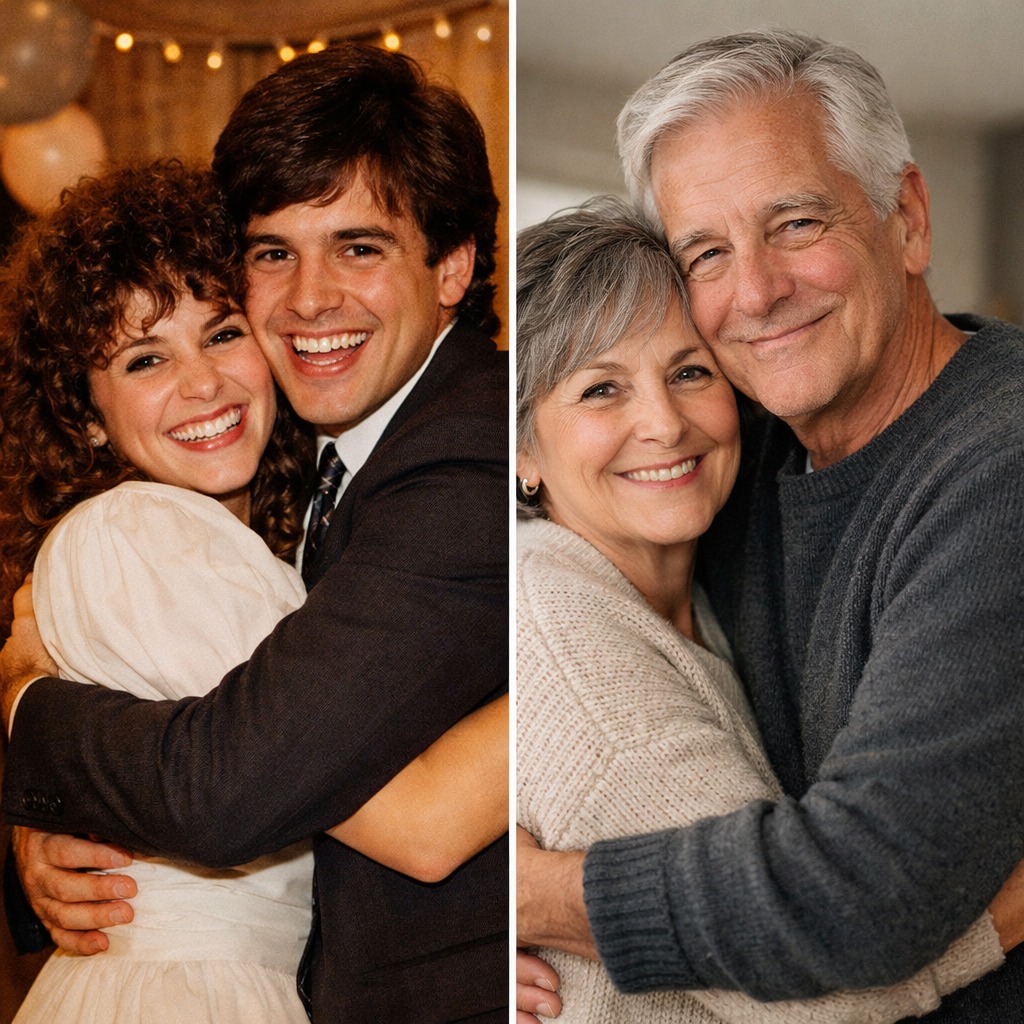
There is something deeply unsettling about watching strangers cry for the man who carried your whole childhood in his rough, steady hands. They touch your shoulder like grief has turned you into glass, and they speak softly, as if any loud sound might break what is left of you.
Five days after Michael died, I stood beside his urn and tried to breathe without falling apart. The room was warm with bodies, lilies, and baked casseroles no one really wanted to eat, but all I could feel was cold.
A framed photo of him sat on the table beside the flowers. He was squinting into the sun in that picture, a streak of grease across one cheek, smiling like someone had just told him a joke he planned to repeat all week.
That photo had lived on his nightstand for years. Seeing it here, under funeral-home lighting and surrounded by sympathy cards, felt wrong in a way I couldn’t explain.
“You were everything to him, Clover,” an older woman whispered as she squeezed my hand. Her grip trembled, and her eyes shone with tears I believed were real.
I nodded because that was what people did at funerals. They nodded, they thanked people, and they swallowed the things they really wanted to say.

What I wanted to say was much smaller and much uglier. You weren’t supposed to leave me too.
Michael had been seventy-eight when pancreatic cancer hollowed him out. It happened so quickly that sometimes I still caught myself thinking I needed to pick up his prescription on the way home, or remind him about the blanket he liked folded at the end of the bed.
I had moved back in the year before, the moment his diagnosis stopped sounding manageable and started sounding final. I drove him to appointments, spooned broth into chipped ceramic bowls he claimed tasted better than the expensive dishes, and sat through long silent evenings while the pain pressed all the words out of him.
I never once thought of it as sacrifice. He had been my father in every way that mattered, and loving him through the end felt as natural as breathing.
Michael met my mother, Carina, when I was two years old. They married quietly, without much fuss, and I grew up never needing anyone to explain what family was because he simply lived the answer every day.
I do not remember life before him. My earliest clear memory is being perched on his shoulders at the county fair, one sticky hand holding a red balloon while the other clutched a fistful of his hair.
He walked with a slight lean even back then, but he never acted like I was heavy. He carried me through crowds, through summers, through scraped knees, through nightmares, through everything.
My mother died when I was four. That sentence has followed me my whole life like a locked door I was taught not to rattle.
I was told she died in a car accident. That was the official version, the family version, the only version, and for most of my life I never thought to ask what else there could be.
Children accept the shape of silence when the adults around them hand it over often enough. I learned very young that grief had rules, and one of those rules was that some questions were impolite.
Michael never made me feel unwanted. He packed lunches with notes in blocky handwriting, sat in the front row at school concerts even when I sang off-key, and taught me how to sand splinters from old wood without ruining the grain.
When I was twelve, a boy in my class sneered that Michael wasn’t my real dad. I came home with burning eyes and locked myself in the bathroom, humiliated by how much those words hurt.
He waited outside the door until I let him in. Then he sat on the closed toilet lid and said, very quietly, “Blood can make people related, kiddo. Love is what makes them stay.”
I never forgot that. It became one of those invisible beams holding up the house of my life.
At the funeral, people moved around me in soft blurs of black fabric and sympathy. Somewhere in the kitchen, silverware clinked against serving trays, and somebody laughed too loudly before choking the sound off in embarrassment.
I stood near the hallway table with a glass of lemonade I hadn’t touched. The house smelled like furniture polish, stale coffee, his aftershave, and that lavender soap he always pretended not to use.
Aunt Sammie appeared beside me with the timing of someone who always knew when an audience might be watching. She wrapped her arms around me and held on just long enough for others to notice.
“You don’t have to stay here alone, sweetheart,” she murmured. “You can come home with me for a while.”
I pulled back just enough to look at her. “This is my home.”
Her smile never changed, but something in her eyes tightened. “Of course it is. We’ll talk later.”
Sammie was my mother’s sister, all polished hair and soft lipstick and careful concern. She had been in and out of my life in a way that made her easy to identify at holidays and impossible to truly know.
She sent cards, sometimes gifts, and opinions no one asked for. Michael tolerated her with a politeness so even it always struck me as deliberate.
As a child, I assumed that was simply adulthood. Looking back, I think restraint was the only thing that kept them civil.
By late afternoon, the living room had thinned out. The pastor had gone, my cousins were carrying empty dishes to their cars, and someone had turned down the organ music that had drifted all day like a ghost pacing the walls.
That was when I heard my name.
“Clover?”
I turned and saw an older man standing a few feet away. He looked to be in his late sixties, maybe older, with a face carved by weather and work, and a tie pulled so tight it seemed to bother him more than grief did.
He held a paper cup in both hands as though he did not fully trust them. There was something familiar in the set of his shoulders, though I knew I had never seen him before.
“I’m sorry,” I said, trying to place him. “Did you know my dad from work?”
He nodded once. “A long time.”
His voice was low and rough, the kind that sounded like gravel under tires. There was engine grease under one fingernail, and the faint sharp scent of peppermint clung to him when he stepped closer.
“I’m Frank,” he said.
I searched his face for recognition and found none. “I don’t think we’ve met.”
“You weren’t supposed to.”
The answer landed strangely between us. I stared at him, suddenly aware of how loud the refrigerator sounded in the next room and how far away everyone else seemed.
“What does that mean?” I asked.
Frank glanced over his shoulder, scanning the room once, then twice. His grip tightened around the cup before he leaned in just enough that no one else could hear him.
“If you want to know what really happened to your mom,” he said, “check the bottom drawer in your stepfather’s garage.”
For a moment, I thought I had misheard him. The room seemed to shift around the sentence, as though the walls themselves had stepped back.
“I’m sorry,” I said. “What?”
His expression changed, but only slightly. There was sorrow in it, and guilt, and something that looked a lot like relief.
“I made him a promise,” he said. “This was part of it.”
My mouth went dry. “Who are you?”
He reached into his coat pocket and handed me a business card. The white rectangle looked absurdly ordinary in a moment that felt anything but.
“I wish your parents were both here for you,” he said. “I truly do.”
Then he stepped away before I could stop him. One second he was there, smelling of old garages and peppermint, and the next he was swallowed by the last cluster of mourners drifting toward the front door.
I stood still, the card pinched between two fingers. The black print on it blurred for a moment before I realized my eyes had filled without warning.
Check the bottom drawer.
The phrase repeated itself in my head all evening. It followed me through handshakes, through goodbyes, through loading leftover food into the refrigerator and folding up extra chairs.
By the time the house emptied, the silence felt different than it had before. It no longer felt like grief alone. It felt like waiting.
I locked the front door and leaned against it for a second. The old wood pressed cool against my back, and all at once I became aware of how large the house sounded with only me inside it.
There were still tissues on the coffee table. A half-empty casserole dish sat on the counter under foil, and one of Michael’s mugs was in the sink because even dying had not made him any better at carrying his own dishes to the dishwasher.
I almost laughed at that. Instead, I pressed my palm to my mouth and stood very still until the wave passed.
The garage sat off the side of the house, attached but always feeling slightly separate, like its own kingdom. Michael had spent half his life in there repairing engines, building shelves, and rescuing furniture other people gave up on.
I did not turn on every light as I walked through the darkened hallway. Somehow, the dimness felt kinder.
When I pushed open the garage door, the hinges gave a long, tired creak. The air inside smelled of cedar, motor oil, dust, and the faint metallic tang of old tools.
Moonlight leaked through the small side window and laid silver bars across the concrete floor. I reached for the hanging bulb over the workbench and clicked it on.
The yellow light revealed everything exactly as he had left it. The pegboard held wrenches arranged by size, coffee cans of screws lined one shelf, and his reading glasses rested upside down beside an open tin of wood stain.
For one irrational second, I expected him to walk in and ask what I was doing out there. I could hear him so clearly in my head that I turned halfway around.
But there was only the garage. Only the hum of the bulb, the distant ticking of the house settling, and my own pulse drumming in my ears.
The workbench cabinets were handmade, heavy, and practical. Michael built things to last, even when the rest of life refused to cooperate.
I crouched in front of the bottom drawer. It was deeper than the others, and the wood around the handle had darkened with years of use.
When I pulled, it barely moved. I tried again, harder this time, and it opened with a low groan that sounded almost human.
Inside was a sealed envelope with my name written across the front in Michael’s thick block letters. Beneath it lay a manila folder, a stack of papers, and one loose sheet torn from a journal.
My chest tightened so sharply I had to sit down right there on the cold concrete floor. I set the envelope in my lap and traced the letters of my name with the tip of one finger.
Clover.
No one else wrote it like that. No loops, no softness, just sturdy lines that looked as dependable as the man himself.
My hands were trembling by the time I slid one finger beneath the seal. The paper gave way with a dry whisper that sounded too loud in the stillness.
Inside was a folded letter.
I unfolded it carefully, already knowing before I read a word that whatever waited on that page was going to alter the shape of my life. The air felt thinner somehow, as if the garage had shrunk around me.
The first line hit me like a hand to the heart.
Clover, if you’re reading this, it means Frank kept his promise.
I stared at the words until they blurred. Then I blinked hard, lowered my eyes, and kept reading.
He had known this day might come. He had planned for it, hidden truth beneath old wood and years of silence, and trusted that when I finally found it, I would be strong enough to survive it.
Outside, the wind brushed the side of the house with a hush that sounded like someone passing by. I gripped the letter tighter and read the next line.
I never lied to you, kiddo. But I didn’t tell you everything.
And right there on the garage floor, beneath the yellow light and the smell of cedar and oil, the story I had lived inside all my life began to crack open.
The letter in my hands felt impossibly heavy, as if Michael’s words were burdening me in ways I had never anticipated. I sat there on the cold concrete floor, the silence of the garage pressing in on me from all sides. Outside, the wind picked up, sending a chill through the cracks in the old walls. But I hardly noticed the cold, not with the storm brewing inside my chest.
I kept my eyes on the page, reading the next part of Michael’s letter over and over again, as though somehow I might misunderstand it if I looked away for even a second.
“Your mom died in a car accident, yes — but she wasn’t just out running errands. She was driving to meet me. We were going to sign the guardianship paperwork that day. You know… to make it official.”
The words hit me like an icy fist. For as long as I could remember, I had been told the same story: My mother was on her way to pick up a few groceries when she lost control of the car, and the crash happened so fast there was no time for anyone to react. That was the version everyone agreed on, the version I’d lived with for more than two decades.
But this? This was a truth so far beyond that story that it felt like the earth had just shifted beneath my feet.
She had been going to meet Michael. She hadn’t been running errands at all. She had been driving to sign papers to make Michael my legal guardian. To make him my father in every sense of the word.
I blinked, trying to focus on the rest of the letter, trying to push back the overwhelming tide of emotions threatening to drown me. But the words blurred together again.
“But she panicked.”
I read it again, more slowly this time, trying to make sense of it.
“Your Aunt Sammie had threatened court. She didn’t think that I was fit to raise you. She said that blood mattered more than love.”
The words burned with a cold fury, and I could feel the heat rising in my face. Aunt Sammie — the woman who had always hovered at the edges of our lives, pretending to care while secretly undermining everything Michael had done for me. The woman who had always made subtle digs at the way Michael had raised me. This was not just about the loss of my mother; this was about control. She had never wanted Michael to be my father, not truly. She had always wanted to take me from him, to put me into her own safe, manageable life where she could control every little detail.
My hands shook as I gripped the letter tighter, the ink smudging under my fingers. I fought the urge to scream.
Michael had known. He had known the real reason for the accident. He had known the weight of what my mother was carrying when she climbed into that car, terrified and panicked, afraid that Sammie would take me from her. He had known how much she trusted him, how much she loved me, and how she had tried to protect me even from beyond the grave.
“Your mom didn’t want a battle. She was scared of losing you. I told her to wait… to let the storm pass. But she got in the car anyway. I should’ve stopped her.”
The guilt in those words was palpable, suffocating. Michael had carried that guilt for all these years, hiding it behind a mask of quiet strength, refusing to let it touch me, because he thought it was his burden to bear. I had always known him to be a man who took on the weight of the world without complaint, but this… this was something different. This was a burden too heavy for anyone to carry alone.
The words didn’t stop. They kept coming, each one peeling away another layer of the story I had been told my entire life.
“After the crash, Sammie tried again. She sent letters, hired a lawyer, and said I had no claim to you. But I had the paperwork. I had this letter from Carina — you’ll see it.”
I gasped, sitting up straighter as the next part of the letter began to form in my mind. There was more. There had been legal battles I had never known about. There were letters, a promise between Michael and my mother, things hidden away from me all these years.
“If anything happens, don’t let them take her.”
The words punched through my chest, making it hard to breathe. My mother’s words, written out for me like a secret pact — a promise she had made, one that had been kept even after her death.
Michael had kept me safe, not because the law gave him permission, but because he loved me. He had fought for me, not just as a man raising a child who wasn’t his, but as a man who knew that love wasn’t about titles or paperwork. It was about what you would do for someone when no one else was watching. When everyone else was trying to take that love away.
“You were never a case file. You were my daughter.”
The tears came then, harder than I could have ever anticipated. I dropped the letter to my lap and pressed my palms against my face, not caring that the garage felt smaller by the second, that the walls seemed to be closing in.
I wasn’t just the child of a woman who had died in a car accident. I wasn’t just a child caught in the middle of a family battle for control. I was Michael’s daughter. He had chosen me. He had chosen me over the law, over blood, over everything. And for the first time in my life, I understood just how much he had given up, how much he had sacrificed to keep me safe, to make sure I never felt like anything less than his.
The anger bubbled up next, hot and fierce. I wanted to scream at Sammie, at everyone who had tried to tear this family apart. I wanted to scream at the injustice of it all. But instead, I sat there, breathing through the rage, letting it wash over me until it passed.
“But I want you to be wary of Sammie. She’s not as sweet as she wants you to believe.”
I read that part again, slower this time, as if Michael was warning me from beyond the grave.
Sammie. The woman who had tried to take me from Michael when I was just a baby. The woman who had always put herself first, who had never really understood the love Michael and I had shared. She wasn’t just my aunt. She wasn’t just a relative. She was someone who had tried to manipulate the system, to bend everything to her will, even if it meant tearing apart a family to do so.
I took a deep breath, pulling the letter back into my lap. The weight of it still lingered, but now it was different. Now I understood why Michael had kept the truth from me for so long. He hadn’t wanted to burden me with it. He hadn’t wanted me to grow up with the knowledge that people had tried to tear us apart.
But now that I knew the truth, it was time to make it right.
The garage around me felt different now. It felt like a space where secrets had been kept for too long, a space that had finally opened up to the truth. I stood up slowly, still holding the letter in my hands, and walked over to the workbench. I placed the letter down carefully, the words still echoing in my mind.
I wasn’t a case file.
I wasn’t just the girl who had lost her mother.
I was Michael’s daughter.
And now it was time to make sure the rest of the world knew it.
The next morning, I woke up before the sun, my mind buzzing with everything I had discovered. The letter from Michael still sat on the kitchen table, the words heavy in the air around me, as if the house itself had absorbed the secrets it carried. But now that I knew the truth, I couldn’t just leave it there. I couldn’t let it sit between me and everyone else, half-hidden like it had been for so long.
I made myself a cup of coffee, but I didn’t drink it. I just held the mug in my hands, letting the warmth seep into my bones while I tried to think clearly. I didn’t have the answers. Not yet. But I knew what I had to do next.
The first thing was to find out exactly what Sammie had done. I needed to know how deep her manipulations had gone, what she’d said to the lawyers, to anyone who could give me insight into the plan she had crafted all those years ago. I couldn’t let her rewrite the story of Michael and me any longer. He had fought for me. He had raised me. And no one — not her, not anyone — could take that away.
I sat down at the kitchen table and pulled out the business card Frank had given me. His name was written in smudged ink, but I could still make it out. Frank. A man who had known Michael and had kept his promise, whatever that meant. It seemed like he was a key to understanding everything. I needed to reach out to him. If he knew Michael as well as he seemed to, then he might know more about the truth I was trying to uncover.
I took a deep breath, grabbed my phone, and dialed the number printed on the card. The phone rang a few times before it was picked up, and I hesitated for a second, unsure of how to begin.
“This is Frank,” a gruff voice answered. “Who’s this?”
“It’s Clover,” I said, my voice shaking despite my attempts to sound composed. “Clover… Michael’s daughter. From the funeral.”
There was a brief pause on the other end, and I could almost hear Frank processing the name. Then he exhaled, and I heard the faint sound of him shifting in his chair.
“Yeah. I remember you. What’s on your mind, kid?”
I swallowed hard, the reality of what I was asking sinking in. “I… I need to know everything. About what happened with my mom, with Sammie. I found the letter. Michael’s letter. He told me things… things I never knew. And I need to understand. I need to know what you meant when you said I should check the bottom drawer.”
Frank was quiet for a long time. Too long. I could hear the crackling of static on the line, and for a moment, I wondered if he was going to hang up. But then his voice returned, softer now, filled with a weight I wasn’t prepared for.
“Look, Clover… What your stepdad did for you, what he kept hidden all these years, it wasn’t just about love. It was about protection. From your aunt, from the courts, from people who didn’t know him like you did. You’re right to want answers. But be careful. You’re not just digging into family secrets. You’re pulling at threads that could unravel everything.”
His words sent a shiver down my spine. This wasn’t just about closing a chapter. It was about finding the parts of my life that had been hidden for far too long, and facing the consequences of that knowledge.
“I’ll be careful,” I promised. “I just need to know what happened.”
There was a long sigh from Frank, a sound that seemed to echo the years of silence and secrecy that had followed Michael’s death.
“I’ll meet you,” he said finally. “I can’t do this over the phone. I’ll meet you at the diner on Main Street at 10 AM. You bring the papers, the letters, whatever you’ve got. And we’ll talk.”
I nodded, though I knew he couldn’t see me. “Okay. I’ll be there.”
We hung up, and I stared at the phone for a moment before glancing over at the letter again. Michael had kept so much from me, hidden it all behind the curtain of his quiet strength. And now, I was finally starting to understand why.
I wasn’t the first to carry the weight of secrets in my family. But maybe, just maybe, I would be the last.
The diner was a small, faded place, with checkered floors and a jukebox in the corner that never seemed to play the right song. I sat at the corner booth, my hands folded neatly in front of me, trying not to look too nervous. The coffee in front of me was lukewarm, but I couldn’t bring myself to drink it. Instead, I waited, my heart thumping with anticipation.
Frank arrived just after 10 AM, walking in like a man who had lived too many years watching time slip away unnoticed. He wore a denim jacket, the sleeves rolled up to reveal thick forearms covered in faded tattoos. His face was older now, the creases deeper, but there was still a spark in his eyes. He was the kind of man who carried the weight of everything he had ever known, but wore it like armor.
He didn’t waste time with pleasantries. He slid into the seat across from me, took a long look at the stack of papers and the letter I had placed on the table, and nodded.
“Guess you’re ready, then,” he said, his voice rough but steady. “You want the truth? You’re gonna get it. But don’t say I didn’t warn you.”
I nodded, my pulse racing. “I’m ready.”
Frank leaned back, folding his arms across his chest, and stared at me for a long moment. “Alright. Your mother… she wasn’t just running errands that day. She was scared, Clover. Scared that Sammie would take you away. That she’d tear your family apart before it even really started. She wanted Michael to be your dad, but she didn’t know how to make it official. And Sammie, well, she wasn’t gonna let that happen. She was determined to control everything — even you.”
I felt a cold rush of anger, sharper now than it had been in the garage. “So, she was the one trying to tear us apart all this time?”
Frank nodded. “Yeah. And Michael, he knew that. He kept the truth from you because he didn’t want you to feel like a pawn in some messed-up family game. But he never stopped fighting for you. He loved you, Clover, and he always did. Even when everything else was stacked against him.”
I swallowed, the weight of his words settling like a stone in my stomach. “What else? What about the lawyers? What else did Sammie do?”
Frank’s face hardened. “She tried to get custody. She had the lawyers, the letters, the threats. She told the courts that Michael wasn’t fit to raise you. That you needed a ‘proper family.’ But Michael had the papers. The ones your mom signed, saying he could raise you if anything happened to her.”
The truth was getting uglier by the second. My stomach twisted as I absorbed it. But I had to know. I had to know everything, no matter how painful.
Frank leaned forward, his hands folding on the table. “That’s why Michael never let you feel like you were caught in the middle. He never wanted you to know the truth, not until you were ready. But now, Clover… now you have to decide what you want to do with it. Do you want to keep fighting for the man who raised you? Or do you want to let it all go?”
I felt the weight of his words sink in. The man who had been my father, my protector, my rock. He had carried this secret for years, carrying the shame and the burden of all the things that had happened. But now it was mine. It was up to me to decide how the story would end.
I looked up at Frank, my mind racing with everything I had learned, everything I still needed to uncover. “I’m going to make sure Michael’s name is on my birth certificate. I’m going to make sure everyone knows the truth.”
Frank gave me a small, approving nod. “That’s the right choice.”
The diner seemed quieter now, the hum of the jukebox fading into the background. I felt lighter, but also heavier, as if I was carrying more than I had before.
I had the truth now. And now, finally, I was ready to claim it.
The following weeks felt like a blur, a whirlwind of appointments, paperwork, and legal battles. I had made my decision. I was going to claim the truth, and I would make sure that Michael’s name — his rightful place in my life — was solidified in every way possible.
The first step was to visit the clerk’s office. I walked in, my palms sweating as I gripped the folder Michael had left me. Inside it were the guardianship papers, the letter from my mother, and the draft that had never been signed. There were also the records from the lawyer Frank had mentioned, all the letters that Aunt Sammie had sent — the threats, the manipulation, the subtle attacks on Michael’s character.
I had never realized how much was at stake for Michael, how deeply he had been willing to fight for me. And now, here I was, about to fight for him.
The clerk behind the counter was a woman I hadn’t met before. She looked up at me with tired eyes, a polite smile playing at the edges of her lips.
“How can I help you?” she asked, her voice too neutral for my liking.
“I’d like to start the paperwork to restore my stepfather’s name on my birth certificate,” I said, holding out the folder. Her eyes flickered over the documents, but she didn’t say anything at first.
“Your stepfather?” she repeated, looking up at me again.
“Yes. Michael was my father. He raised me, and I want his name on my certificate,” I explained, trying to keep my voice steady, though it cracked a little at the edges.
She studied me for a moment, then nodded. “Alright, I’ll need to check the records and make sure everything’s in order. Please have a seat.”
I sat down, the weight of the folder pressing into my lap as I waited. Time seemed to stretch and bend in the silence of the room, as though the world was holding its breath. The clerk eventually returned, holding a few sheets of paper in her hands.
“You’ll need to fill out a petition,” she said. “We’ll have to request a hearing, and you may need to provide more documentation from your stepfather’s estate. You’ll also need to have a lawyer present for the hearing. It’s not a simple process.”
I nodded, absorbing the information. It wasn’t going to be quick. Nothing that mattered ever was. But I was ready. Michael had spent years carrying this secret alone, and now I was the one who would carry it into the light.
“I understand,” I said. “I’ll get everything together.”
The clerk handed me a form. I filled it out slowly, my thoughts swirling with the enormity of what I was doing. I wasn’t just changing a name. I was making a statement — not only to the world, but to myself. I was claiming Michael, and I was claiming the love he had given me, the love he had fought for in ways I could now understand.
The next step was a call to the lawyer Frank had mentioned. I hadn’t spoken to him directly yet, but I knew that without his help, everything I was trying to do could unravel before it even started.
I made the call late that afternoon, hoping I wouldn’t sound too desperate. I didn’t know this lawyer, but I trusted Frank’s judgment. If he was willing to vouch for him, then I was willing to trust him, too.
The phone rang several times before it was answered.
“Law offices of Walker & Associates,” a deep voice said on the other end. “How can I help you?”
“This is Clover Reed,” I said. “I was referred to you by Frank. I need help with a guardianship case. I’m trying to restore my stepfather’s name on my birth certificate.”
There was a brief silence. Then, the voice softened, understanding creeping in.
“Ah, yes. Frank mentioned you might call. I can help with that. Meet me tomorrow morning at my office, and we’ll go over the details. Bring anything you have regarding the guardianship documents.”
I thanked him and hung up, feeling a sense of relief that I hadn’t expected. The first hurdle had been cleared. Now, I just had to keep going.
The next morning, I arrived at the lawyer’s office, a cold wind biting at my cheeks as I walked through the glass doors. Inside, the building smelled of coffee and fresh paper. The lawyer, a man named Thomas Walker, greeted me with a handshake. He was tall, with salt-and-pepper hair and glasses that made him look older than he probably was. His suit was neat, but not flashy, and his demeanor was calm, almost too calm for the weight of what I was asking him to do.
“I’ve looked over the documents Frank sent me,” he said as we sat down. “It’s a complicated case, but it’s not impossible. We’ll need to gather more evidence, though, especially to prove that your stepfather, Michael, had a valid claim to your guardianship.”
I nodded. “I have everything from the letter, the guardianship papers, and the legal threats from my aunt, Sammie. I’m not sure what else you need, but I’m willing to do whatever it takes.”
Thomas studied me for a moment, then nodded. “Alright. The legal threats are helpful, but we’ll also need to establish a clear history of your stepfather’s relationship with you. If you can get affidavits from people who knew both of you, that would be invaluable. I’ll also contact the clerk’s office and make sure we’re getting the right documents.”
I felt a mix of anxiety and determination settle in my chest. The road ahead wouldn’t be easy, but it felt like the right one. For once, I wasn’t running from the truth. I was embracing it, even if it meant facing the parts of my family’s history that had been buried for so long.
As we went over the next steps, I could feel the weight of my decision press on me in a way I hadn’t anticipated. This wasn’t just about legal paperwork anymore. This was about restoring the truth — about Michael, about my mother, and about the family that had been torn apart by secrets and lies.
The weeks passed in a blur of legal appointments and late nights spent organizing paperwork. I got affidavits from neighbors, from old family friends, and from anyone who could speak to the life Michael and I had built together. Each signature, each piece of evidence, felt like a small victory, but I knew the real battle was still ahead.
And then, the day of the hearing came. I stood outside the courthouse, my heart racing in my chest. It felt like everything had been building to this moment, and I was terrified I might fall short.
But I didn’t. I couldn’t.
When the doors opened and I walked into that courtroom, I knew that this was my fight to win. Michael had fought for me. Now, it was my turn.
The courtroom was cold, the kind of cold that seemed to seep into your bones the moment you stepped through the doors. The walls were lined with dark wood, and the air had a sterile, formal quality to it that made my throat dry. My palms were slick with sweat as I gripped the folder in my hands. The papers inside seemed heavier now, carrying not just the weight of legalities but the weight of everything I had learned over the past few weeks — the secrets, the lies, the promises.
I had never been inside a courtroom before. I had no idea what to expect, other than the sense that this was the final piece of a story I had been piecing together my whole life.
I could hear my heart pounding in my ears as I sat down at the front of the room. My lawyer, Thomas Walker, sat beside me, flipping through the paperwork one last time. His face was unreadable, but I could tell he was thinking, planning the next move. Across from me sat Aunt Sammie. She looked composed, her blonde hair neatly pulled back in a low bun, her pearls gleaming against her pale skin. She had a look of calm confidence, like she was sure of herself, like she knew something I didn’t.
But I wasn’t intimidated. Not anymore.
The judge, an older woman with steel-gray hair and glasses perched on the end of her nose, called the court to order. Her voice was sharp, cutting through the silence like a knife.
“We are here today to review the petition filed by Clover Reed to amend her birth certificate and officially name Michael Reed as her father. The opposing party, represented by Mrs. Sammie Blake, has contested the request. We will proceed with opening statements.”
I took a deep breath, my hands trembling slightly as I turned to Thomas. He gave me an encouraging nod before standing up and walking to the front of the courtroom.
“Your Honor, my client, Clover Reed, is seeking to amend her birth certificate to reflect the truth of her upbringing,” Thomas began, his voice steady and authoritative. “Michael Reed, Clover’s stepfather, raised her as his own from the age of two, and he was her father in every sense of the word. This petition is not simply a matter of legalities — it is a matter of recognizing the bond that existed between them, a bond that was built on love, not blood.”
I couldn’t help but feel a swell of pride as he spoke. This wasn’t just about me. It was about Michael — the man who had given me everything, even when he hadn’t been given the right to. I had always known that Michael was my father, but now, I was fighting to make the world see it too.
Thomas continued. “We have provided affidavits from family, friends, and neighbors who can attest to the relationship between Clover and Michael. We also have legal documentation proving that Michael was prepared to legally adopt Clover, if not for the tragic circumstances surrounding her mother’s death. My client is asking for the court to recognize this fact, and to allow the official records to reflect the truth.”
I could feel Aunt Sammie’s eyes on me, cold and calculating. She hadn’t said a word yet, but I knew she was waiting for her turn, just like she always did. She was going to fight this. She always fought. She had spent years trying to take control, trying to rewrite our history, and I had a feeling she wouldn’t back down now.
When Thomas finished, the judge turned to Sammie.
“Mrs. Blake, do you have an opening statement?” she asked.
Aunt Sammie stood slowly, smoothing her skirt as she did. Her smile was practiced, her eyes flickering to me before she began to speak.
“Your Honor,” she started, her voice sweet but laced with an edge of authority. “While I do not contest the fact that Michael Reed played a role in raising Clover, I must point out that the law does not recognize this relationship. Clover’s biological mother was the only one with legal standing to make decisions regarding her guardianship, and the fact remains that Michael Reed was never officially her father. The petition filed by my niece is, in effect, an attempt to rewrite history. My sister’s death was a tragic accident, and we all mourned it. But it does not change the fact that Michael was not her biological father, and as such, his claim to guardianship should be questioned.”
Her words struck like a blow. The cold, calculated way she phrased everything, as though Michael’s love for me didn’t matter, as though he hadn’t been my father for all those years — it was all so… clinical. As if I were just a piece of paper to her, just a case file to be disputed.
Thomas was on his feet in an instant, his voice sharp. “Your Honor, with all due respect, Mrs. Blake is trying to make this about the law, when this case is about something far more important — the truth. Michael Reed wasn’t just a man who helped raise Clover. He was the man who fought to be her father, who fought against your own attempts to take her from him. And as for the law, the very papers we present today are proof that Michael had every right to be her father, legally and otherwise. He never sought to replace anyone — he only sought to protect the little girl he loved.”
Sammie’s face tightened, but she didn’t interrupt.
The judge looked between the two of them before turning her gaze to me. Her expression softened slightly, and I could see that she was considering the depth of everything Thomas had said.
“Ms. Reed,” the judge said, her voice gentle now, “how do you feel about the petition you’ve filed?”
I took a deep breath, standing slowly. All eyes were on me, the weight of everyone’s expectations suddenly pressing down on me like a thousand pounds. But I didn’t flinch. I couldn’t.
“I feel that this petition is the right thing to do, Your Honor,” I began, my voice steady. “I know that Michael wasn’t my biological father, but he was my father. He raised me. He loved me. He fought for me when no one else did, and when my mother died, he didn’t leave me to fend for myself. He protected me. He gave me a life. I don’t want to change my past, but I do want it to be recognized for what it truly was. Michael was the father I always had, and I want the world to see that.”
There was a pause in the room. A silence so deep it felt like it could swallow me whole. And then the judge nodded, her eyes soft with understanding.
“I believe we have heard enough,” she said after a long moment. “We will take a brief recess before moving to a decision.”
As I sat back down, I felt like a weight had lifted off my shoulders. I had spoken my truth. I had told the court — and the world — who Michael really was to me. And no one could take that away. Not Aunt Sammie, not the law, not anyone.
The recess was brief. The judge returned, and the room fell silent once more.
“I’ve considered all the evidence presented,” the judge said, her voice firm but compassionate. “This court recognizes that the relationship between Ms. Reed and Michael Reed was one of love, commitment, and care. It was not just a stepfather-daughter relationship; it was a father-daughter relationship in every way that matters. The petition to amend the birth certificate is granted. Michael Reed’s name will be added as the legal father of Clover Reed.”
The words hit me like a wave. For the first time in my life, I felt like the world was finally seeing me for who I truly was — Michael’s daughter, no matter what anyone else had tried to say.
As the court session ended and people began to file out, I stood for a moment, alone in the stillness of the room. It was over. The fight was done. Michael’s name would finally be on my birth certificate, where it belonged.
Outside, the world felt different. The sun seemed brighter, the air warmer. And when I looked up at the sky, I could almost hear Michael’s voice, like he was still there, still watching over me, still proud of the woman I had become.