I have a good life now. I really do. My mornings are filled with packed lunches and lost sneakers, and my evenings disappear into soccer practice, spelling homework, and bedtime stories whispered in the dark.
From the outside, it looks like the kind of life people fight for. Safe, warm, ordinary in the best possible way. But there is one memory I have never been able to bury, no matter how many years pass.
It lives in me like a splinter under skin. Invisible to everyone else, but still sharp when it catches. Sometimes it comes back so suddenly that I can almost smell the roses, hear the clink of champagne glasses, and feel the stiff lace of my wedding dress against my arms.
Thirteen years have passed since that day. Thirteen years since the moment my wedding turned from a dream into something else entirely. And yet when I think about it, my heart still tightens exactly the way it did then.
It was supposed to be the happiest day of my life. That is what every bride tells herself, isn’t it? You spend months planning one perfect day and convince yourself that love can be wrapped in white satin, golden light, and a carefully timed first dance.
Sometimes I wonder what would have happened if that moment had never taken place. If the cake had remained untouched, if the laughter had stayed gentle, if humiliation had not arrived dressed as a joke. But then I look at my life now, at everything that came after, and I know the truth is more complicated than regret.

Back then, I was twenty-six years old. I thought I knew exactly what love looked like. I thought it was charm and consistency and a man who remembered small things when the rest of the world was too busy to notice them.
I met Ed in a tiny coffee shop downtown. It was the kind of place with chipped wooden tables, handwritten chalkboard menus, and a bell above the door that rang every time someone stepped inside. I used to slip in there during my lunch breaks to escape the fluorescent lights and endless meetings of my marketing job.
At first, he was just part of the background. Every afternoon, almost like clockwork, he walked in wearing a tie slightly loosened at the neck and ordered the exact same caramel latte. He always smiled at the barista, always left a tip, and always stood near the window while he waited.
Then one day, he looked at me and said, “Let me guess. Vanilla chai with extra foam?”
I laughed before I could stop myself. “Not even close,” I said, reaching for my wallet. He looked almost offended by his own failure, which only made me laugh harder.
The next day, he tried again. “Okay, definitely a cappuccino. No sugar. You look like a no-sugar person.” I shook my head and told him he was wrong, and he pressed a hand dramatically to his chest like I had wounded him.
That became our routine before we even admitted it was one. He guessed. I corrected him. And every single time, he acted as if my actual order was the most surprising twist he had ever encountered.
A week later, he leaned against the counter with a grin and said, “You’re an iced mocha girl. I’m sure of it.” I raised an eyebrow and said, “At this point, I think you’re just making things up.”
He laughed, low and easy, and for the first time I noticed how warm his laugh was. Not polished. Not practiced. Just natural enough to make the whole room feel less crowded.
Then, on a rainy Tuesday that smelled like wet pavement and espresso beans, he finally got it right. I had barely stepped through the door when he looked over and said, “Iced coffee, two sugars, splash of cream.”
I stopped in my tracks. “How did you know?” I asked, genuinely stunned. His grin widened like he had just won something important.
“I’ve been studying you for weeks,” he said. Then he lifted one shoulder and added, “Mind if I buy it for you?” There was something playful in the way he said it, but something earnest too, and that was what made me say yes.
We sat by the window for the rest of my lunch break. What I thought would be a polite twenty-minute conversation stretched until I was checking the time in panic and laughing at how late I was going to be. He told me he worked in commercial real estate, that he hated olives, that he had broken his arm at twelve trying to impress a girl on a skateboard.
I told him about my job, about my obsession with old black-and-white movies, and about how I always read the last page of a novel first if I was nervous about being disappointed. He teased me for that, but not in a mean way. More like he was delighted to have found a flaw he could treasure.
That coffee turned into a real date three days later. Then another the weekend after that. Before I even realized what was happening, Ed had become the person I reached for first when something funny happened, when something awful happened, or when I simply wanted to hear a voice that made the day feel softer.
He was thoughtful in ways that didn’t look flashy from the outside. He remembered I loved sunflowers, so instead of buying expensive bouquets, he would show up with a single bright stem and act like he had delivered treasure. He packed my favorite sandwiches for picnics in the park and pretended not to notice when I stole the pickles off his plate.
When I had a bad day, he somehow always knew. He would appear at my apartment with ice cream and some terrible joke so ridiculous it made me groan before it made me laugh. And because he never made kindness look like effort, I mistook it for character.
For two years, he made me feel like the most important person in the room. That kind of attention can feel like love when you are standing inside it. It is only later, sometimes much later, that you learn attention and respect are not always the same thing.
Still, back then, I believed in us completely. I believed in his smile, in his warm hand closing around mine, in the future we kept building with our words. Marriage felt less like a risk and more like the obvious next chapter of a story already written.
The proposal happened on a pier at sunset in late September. The sky looked unreal, streaked in orange and pink, and the water below us moved in slow dark ripples as boats rocked in the distance. I remember the wind lifting my hair and the strange nervousness in his face before I understood why.
He dropped to one knee so suddenly that I gasped. For one wild second, I thought he was joking, because Ed was always joking, always turning life into something lighter. But then I saw the ring in his hand and how badly his fingers were trembling.
“Lily,” he said, and my name sounded different in his mouth that night. More serious. More fragile. “Will you marry me?”
I don’t remember every word he said after that. I remember fragments, phrases about forever and home and how he couldn’t imagine a life that didn’t have me in it. But mostly I remember the pounding of my own heartbeat and the way the whole world seemed to narrow to that one impossible moment.
“Yes,” I said, before he had even finished. Then I laughed and cried at the same time because apparently that is what happens when joy overloads the body. He slid the ring onto my finger, stood up, and kissed me while the sun disappeared behind the water.
For a while, I thought that was the most romantic moment of my life. I thought nothing could ever take its place. I was wrong about that too, though not in the way I expected.
The next step was introducing him more formally to my family. My mother already knew about him, of course. She had heard enough stories to feel like she knew his coffee order better than her own. But this was different. This was the dinner where the future became real.
And then there was Ryan.
My older brother had been protective of me for as long as I could remember. When our father died, I was eight and Ryan was only twelve, but grief had a way of forcing children into shapes they never asked to wear. Almost overnight, he became the one who watched doors, who checked locks, who walked beside me instead of ahead of me.
He never said that he felt responsible for us. He didn’t have to. It lived in the way he looked at my mother when she was tired and the way he looked at me whenever a man stood too close.
Ryan had always judged the men in my life with an intensity that made some of them visibly sweat. He didn’t care how charming they were or how impressive their jobs sounded. He cared about whether they treated me like I mattered when no one was clapping.
So yes, I was nervous about that dinner.
My mother cooked roast chicken with lemon and rosemary. She set the table with the good plates, the cream-colored ones she only used for holidays and important guests. And when Ed arrived with flowers for her and a bottle of wine for Ryan, I silently begged the universe not to let anyone ruin the night.
To my relief, Ed seemed completely at ease. He laughed at Ryan’s dry jokes, asked thoughtful questions about his work, and listened to my mother’s stories with the kind of focused politeness that made older women melt instantly. By the time dessert came out, the air had softened.
I kept stealing glances at Ryan, trying to read the expression on his face. He was hard to impress, and he knew it. But then, across the table, he caught my eye and gave me the smallest nod.
It was such a tiny gesture. Barely there. But I knew what it meant.
He approved.
That mattered more to me than I wanted to admit. Ryan had spent most of my life being my quiet alarm system. If something was wrong, he usually felt it before I did.
So when he gave me that nod, I took it as proof that I had chosen well. I tucked it into my heart like a blessing and moved forward without fear.
The months leading up to the wedding passed in a glittering blur. There were venue tours and seating charts and flower samples spread across my dining table. There were endless phone calls, last-minute changes, and the strange way time both crawled and sprinted when something important was waiting at the end of it.
We invited one hundred and twenty guests. I remember the number because I counted the response cards over and over, terrified I had somehow made a catastrophic mistake. Every detail felt enormous then, as if one wrong ribbon or one missing centerpiece might crack the whole day in half.
The reception hall looked beautiful when everything finally came together. White roses spilled from crystal vases. Fairy lights shimmered against the walls like trapped stars. And the golden accents I had obsessed over gave the room a warmth that made it feel elegant without being cold.
I thought I was building a memory I would carry forever. In a way, I was. I just didn’t know the memory would cut.
The morning of the wedding arrived in a rush of steam, perfume, and nerves. My bridesmaids crowded around me in silk robes, curling irons hissing on every surface, while my mother tried not to cry and failed almost immediately. Every time I looked in the mirror, I felt a strange jolt of disbelief.
I looked like a bride. Like someone standing on the threshold of the life she had asked for. The white lace, the long veil, the delicate buttons down the back of the dress—it all felt like a costume made of hope.
When it was finally time to walk down the aisle, my hands were shaking. My mother squeezed them hard and whispered, “Your father would be so proud of you.” That almost undid me before the music even began.
The church was glowing with late afternoon light. Sun filtered through stained glass in jeweled colors, casting blue and red shadows across the polished floor. And there, at the end of the aisle, stood Ed.
He looked at me as if I were the only thing he could see. It was the kind of look every woman hopes for on her wedding day. Soft, awed, almost disbelieving, as though he had just been handed the most precious thing in the world and was terrified of dropping it.
My mother cried openly as I walked past her. Ryan stood beside her in a charcoal suit, his face solemn but proud, his eyes locked on me like he was memorizing every second. I remember thinking that I had never felt more loved than I did in that moment.
The ceremony itself was perfect. Or at least it felt that way from the inside. We said our vows beneath an arch of roses while the church held its breath around us.
When the pastor said, “You may kiss the bride,” Ed lifted my veil with such tenderness that my eyes filled with tears. Then he kissed me like no one else existed, and for one shining second, I thought, This is it. This is the moment I will remember forever.
But weddings are strange things. People think the big moment is always the aisle or the vows or the kiss. They don’t understand how quickly a life can split open in some smaller, almost silly corner of the day.
By the time we reached the reception, everyone was flushed with champagne and excitement. Music swelled through the room. Glasses clinked. My cheeks hurt from smiling, but it was the good kind of ache, the kind that made me feel surrounded by joy.
There were speeches first. My maid of honor cried halfway through hers and had to start over. My mother said I had been stubborn since birth and looked directly at me when she said it, making half the room laugh. Then Ryan stood up, straightened his jacket, and gave a toast so simple and heartfelt that I had to press my lips together to keep from breaking down.
“To my sister,” he said, raising his glass. “May she always be cherished, protected, and loved the way she deserves.” His eyes flicked briefly to Ed when he said those words, and though I barely noticed it then, I would think about that glance for years.
Dinner followed, then dancing. The room turned softer as the evening deepened, the fairy lights glowing warmer against the dark outside the windows. At one point, Ed pulled me close on the dance floor and whispered, “You’re the most beautiful thing I’ve ever seen.”
I believed him. Why wouldn’t I? His hand was warm at my waist, his forehead resting briefly against mine. I had no reason yet to imagine how quickly warmth could shift into something sharp.
And then the cake was rolled out.
I had spent weeks choosing it. Three elegant tiers with ivory frosting, delicate sugar flowers, and gold leaf details so fine they looked painted on. It was almost too beautiful to cut, and yet I had been looking forward to it in that silly, sentimental way brides do.
I imagined we would laugh softly, guide the knife together, and feed each other a bite while everyone clapped. It wasn’t a major moment, not really, but it was one of those tiny rituals that make a wedding feel complete. Sweet, harmless, easy.
Ed wrapped one hand over mine as we held the knife together. The photographer circled us, calling for us to look up, then down, then smile at each other. Our guests leaned forward in their chairs, phones lifted, waiting for the cute little moment they expected.
We cut the first slice. Applause broke out around us.
I remember turning toward him with frosting on the edge of the fork, smiling, ready to feed him a bite.
And then I saw something flash in his expression.
Not anger. Not cruelty exactly. Something looser, more careless. The look of a man who thinks the room belongs to him and whatever he does next will be forgiven because everyone will call it fun.
His hand moved faster than my mind could catch up.
The last thing I remember before everything changed was Ryan rising from his chair.
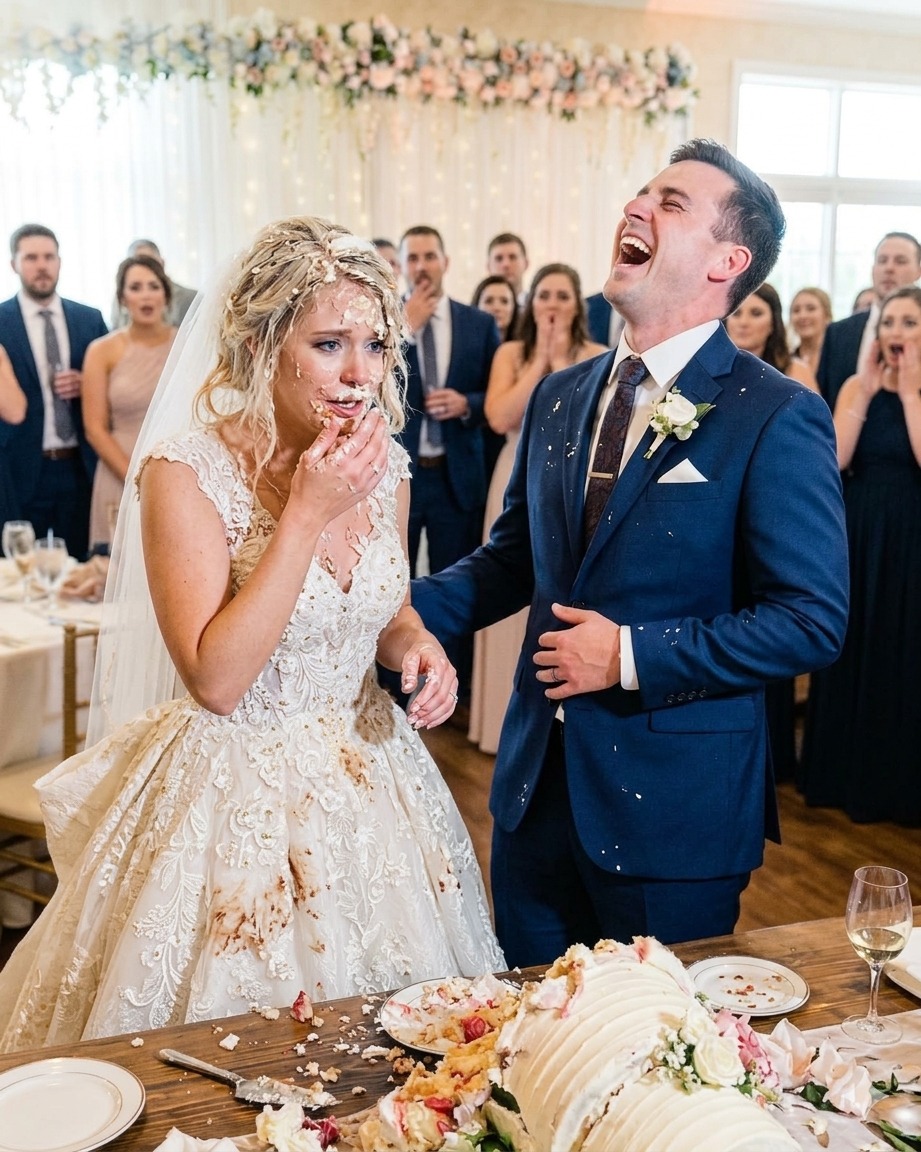
The second Ed shoved my face into the cake felt like an eternity.
It wasn’t just the surprise of it—though that was jarring enough. It was the complete absence of remorse in his actions, the way he laughed as if this was the most natural thing in the world. The sweet scent of buttercream and the cold weight of frosting against my skin. The stickiness in my hair, the smeared makeup, the ruined dress. I couldn’t even see through the thick veil of white frosting clouding my eyes, and I heard the awkward gasps of the crowd.
And then the laughter.
Ed chuckled as though nothing was wrong, wiping frosting from his finger, clearly not realizing—or maybe not caring—that his ‘joke’ had obliterated any semblance of grace from the moment. I wanted to scream. I wanted to run out of that room, but instead, I stood there, frozen, my face pressed against the cake as I fought back the tears.
The room fell silent, the once joyful hum replaced by an uneasy tension. I could feel every single gaze on me, the uncomfortable shift in the atmosphere. My mother’s face, pale and shocked, and Ryan’s posture stiffening beside her. I tried to catch my breath, but all I could think of was how humiliated I felt, how small and insignificant I became in front of everyone I loved.
As I slowly pulled my face from the mess, I felt the weight of my veil tugging at the ruined fabric. The world around me felt distant, muffled by the pounding in my chest. I could barely register the apology that was surely coming from Ed’s lips, or the pitiful laughter that followed. I couldn’t concentrate on anything other than the need to leave, to escape this moment that had already spiraled out of control.
But then, from across the room, I saw it.
Ryan stood up.
The scraping sound of his chair against the floor was sharp, loud enough to cut through the thick tension that had enveloped the room. It drew everyone’s attention—everyone’s attention except Ed’s. The smirk on his face faltered, but it was too late.
Ryan moved swiftly, his footsteps purposefully heavy, his eyes locked on Ed with a calm, terrifying precision. In one smooth motion, Ryan crossed the room and grabbed Ed by the back of his head. The shock on Ed’s face was almost comical, but there was no time to laugh. Ryan didn’t hesitate.
He shoved Ed’s face directly into the cake. Not gently. Not teasingly. He pushed him down with a force that had Ed stumbling and losing his balance. The frosting splattered in every direction, covering Ed’s face, his tuxedo, his hair. The room went silent.
Ryan didn’t stop there. He pressed Ed’s face deeper, grinding the man’s face into the cake until he was completely drenched, as though the entire wedding cake had been poured over him. There was no hesitation in Ryan’s actions—no second thought, no mercy. Only a quiet, unflinching resolve to make Ed feel the exact humiliation I had just endured.
When Ryan finally released him, Ed stumbled backward, his face a grotesque mess of cake and frosting, eyes wide in disbelief. He stood there for a moment, his tuxedo dripping with frosting, his hair soaked and sticking to his face. It was almost impossible to recognize the man who had been laughing just moments before.
Ryan stepped back, surveying his work with a cold, deliberate calmness.
“This is the worst joke you could have pulled,” Ryan said, his voice low and steady. “You just humiliated your wife in front of everyone she loves.”
Ed wiped the frosting from his eyes, his anger bubbling up, but he didn’t move toward Ryan. Instead, he looked at me, the tears I had struggled to hold back finally threatening to fall. My face, my hair, my dress—all completely ruined. And all because Ed thought it would be funny to push my face into the cake.
“Does it feel good?” Ryan’s voice rang out again. “Because that’s exactly how you just made Lily feel.”
For a long moment, Ed said nothing. Then, his face twisted with anger, and he shouted at Ryan, his voice sharp and venomous.
“You ruined the wedding for your sister!” Ed snapped, wiping frosting from his lips, his eyes wild with fury. “This isn’t about you. Stay out of it.”
But Ryan wasn’t done. His gaze never left me as he spoke, his words softening as he turned back to me.
“Lily… think very carefully if you want to spend the rest of your life with someone who disrespects you like that.”
My stomach turned as I realized how close to the truth Ryan’s words were. How had I let myself believe that Ed was someone worthy of my trust, my love?
Before I could gather my thoughts, Ed was already storming out of the room, leaving behind a trail of frosting and shattered pride.
The rest of the evening was a blur. My mind felt numb, and my body felt disconnected, as if I were floating above the scene I had never imagined. The reception continued, but the laughter felt hollow now. The music too loud. The clinking of glasses somehow felt mocking.
Guests whispered among themselves, some shocked by the display, others congratulating Ryan for stepping in. Everyone tried to carry on as if nothing had happened, but the wound was already there, bleeding beneath the surface. The night had been marred by that moment, and I couldn’t escape it.
When the evening drew to a close, and the guests began to leave, I sat alone in our apartment, still wearing my wedding dress. The gown felt heavier than ever, a reminder of everything that had gone wrong. The sparkles of the evening had all but faded. Instead, I was left with the sound of my own heartbeat pounding in my ears, and the weight of the terrible truth that had just unfolded.
Ed didn’t come home that night. I waited for him to walk through the door, to apologize, to tell me this had all been some horrible mistake. But when the night stretched into the early hours of the morning, I realized he wasn’t coming.
It wasn’t until morning that he finally arrived, looking exhausted, his eyes red from lack of sleep. He walked straight toward me, dropping to his knees as if he couldn’t bear to stand. The humility in his posture was jarring, the complete opposite of the man who had been so confident only hours ago.
“I’m so sorry,” Ed said, his voice thick with emotion. “I didn’t understand until last night, until Ryan made me feel what I made you feel.”
He shook his head, tears brimming in his eyes. “I thought it would be funny. I didn’t realize how badly I humiliated you. I made you feel like nothing.”
He reached for my hand, but I pulled away. His apology didn’t feel enough. It didn’t erase the shame, the pain, the memories of that humiliating moment.
I listened to him beg for forgiveness, but my mind kept returning to Ryan’s words: Think very carefully if you want to spend the rest of your life with someone who disrespects you like that.
It wasn’t an easy decision. It wasn’t a decision made in the heat of the moment. But it was the only one I could make.
I told Ed I needed time. He agreed to give it to me, though I could see the fear in his eyes. I could see how desperate he was to undo the damage. But no apology, no tears, could erase the feeling of betrayal that had settled in my chest.
The days that followed were filled with silence. Ed stayed at his parents’ house, and I remained in our apartment, unsure of what came next.
Ryan checked on me every day, never pressuring me, but always there. He helped me clean up the remnants of our wedding day—scrubbing cake out of the carpet, wiping frosting from the walls. And as we worked, he never stopped reminding me how important it was to protect my heart, to never settle for someone who couldn’t treat me with respect.
Slowly, time began to heal the wounds. But I would never forget that day, or the way I had learned to trust my brother’s judgment more than my own.
Days turned into weeks. Weeks blurred into months. And yet the memory of my wedding day—the cake, the laughter, the humiliation—remained sharp, haunting me in quiet moments when I least expected it. Ed tried to reach out, leaving messages, sending flowers, even writing long letters that never seemed to say enough. But the pain of what had happened festered inside me like a wound that had never properly healed.
I knew what everyone expected. They expected me to forgive him. They expected me to move on, to return to the life I had planned with him, to pretend the wedding had been some sort of mistake that could be erased with time and a few heartfelt apologies. But I couldn’t shake the feeling that things had changed irrevocably. That what had happened wasn’t just a poor joke, but a revelation of something deeper—a fundamental disrespect that had been hiding in plain sight.
Ryan was my rock during those days. He didn’t push me. He didn’t tell me what I should do, who I should forgive, or how long I should grieve. He simply stood by me, as he always had. I could see the worry in his eyes, the protective gleam that never seemed to fade when Ed’s name was mentioned. But he never judged me for wanting space. For needing time to process what had happened.
The weeks passed in a blur of empty evenings and long, silent nights. I spent hours thinking, staring out the window, wondering if it was possible to forgive someone for something so cruel. I thought about my future. The life I had once imagined for myself—Ed and I, growing old together, raising kids, building a home. Now, I couldn’t picture that future anymore. It felt foreign, as if it belonged to someone else.
Then, one rainy afternoon, I received a letter from Ed. It was different from the others. There was no apology in the usual sense. No begging for forgiveness, no empty promises. Instead, it was a letter that felt almost like a confession, a raw expression of guilt and regret.
The words he wrote were simple, but they hit me harder than any grand apology could have.
“Lily, I have spent so much of my life trying to make people laugh, to be the one everyone can rely on to bring joy. But I’ve forgotten what it means to be kind. I’ve forgotten what it means to respect the people who truly matter. That night, I saw myself in a way I never had before. And I can’t undo it. I can’t change the fact that I hurt you. But I will carry this with me for the rest of my life, and I will never forget what I did. I’m sorry for making you feel less than. For making you feel small. You deserved so much more than that. And I’m sorry I failed you.”
The letter hit me harder than I thought it would. I found myself sitting on the couch, the rain tapping against the windows as I read it again and again. Each line seemed to cut through the numbness I had been carrying. The weight of his words—the acknowledgment that what he did wasn’t just a mistake, but a fundamental failing of character—felt like a soft, painful truth.
But there was still a part of me that wasn’t ready to forgive him. I wasn’t sure if I ever would be.
That evening, I called Ryan. He answered on the second ring, as he always did.
“I got the letter,” I said, my voice shaky despite my best efforts to remain composed. “It’s different, Ryan. It’s not like the others. He actually seems sorry… but I don’t know what to do with it.”
There was a long pause on the other end of the line before Ryan finally spoke.
“You don’t have to do anything, Lily. You don’t owe him your forgiveness. You owe it to yourself to heal, however that looks. Take your time. You’re allowed to feel whatever you’re feeling.”
“I know,” I said, squeezing my eyes shut. “I just… I don’t know if I can ever look at him the same way again.”
Ryan’s voice softened. “Maybe you won’t. And that’s okay. Sometimes, love isn’t about whether you can forgive someone—it’s about knowing when you’re better off without them. You don’t have to choose right now. You just have to take care of yourself.”
Those words stayed with me long after I hung up the phone. I wasn’t ready to decide anything about Ed, not yet. But Ryan had given me permission to take things one step at a time. He had reminded me that I didn’t have to rush the healing process, that I could take as long as I needed.
For the first time since the wedding, I felt like I had control over my own life again. I wasn’t going to let the events of that day define me. I wasn’t going to let Ed’s mistake shape my future. Whatever I decided, I knew that I deserved to be treated with respect, with love, and with care.
And if Ed couldn’t offer that, then maybe it was time to let go.
As the days passed, I spent more time focusing on myself. I threw myself into my work, rediscovered old hobbies, and took long walks in the park to clear my head. It felt good to breathe again, to not be consumed by the weight of the past.
Then, about two months after the wedding, Ed called. He asked to meet, to talk in person. My first instinct was to say no. But then I remembered what Ryan had said. I didn’t have to decide anything in a rush. If anything, this meeting would give me the space to ask the questions I had been afraid to ask before.
So, I agreed.
We met at a quiet café, the kind that had soft music playing in the background and the smell of fresh coffee in the air. When I saw Ed, it took everything in me not to flinch. He looked different—tired, worn down by guilt. The man who had once seemed so confident, so sure of himself, now seemed small, unsure.
“I’ve been thinking a lot about everything,” Ed started, his voice quiet. “About how I treated you, about how I treated everyone. And I want to say this to you—looking back, I realize I wasn’t just making a bad joke. I was making you feel like you weren’t worth the respect you deserve.”
He paused, eyes meeting mine. “And I’ll never forgive myself for that. I hurt you, Lily. I don’t expect you to forgive me. I don’t even deserve it. But I want you to know I’m sorry. And if you ever decide you want to talk again, I’ll be here.”
I nodded slowly, the weight of his words settling in. It wasn’t an apology that erased the past, but it was one that acknowledged the truth. I didn’t have an immediate answer for him. But for the first time, I felt a small glimmer of closure.
“I don’t know what the future holds,” I said softly, meeting his gaze. “But thank you for understanding why what you did was wrong. And maybe… maybe we’ll both figure out what we need in time.”
We sat there for a while, sipping our drinks in silence, two people trying to figure out what to do with the aftermath of something that had shattered their lives.
As I left the café, I realized that I didn’t need to rush the decision. Ed and I might never go back to what we once were, but that didn’t mean I couldn’t move forward. My life was still mine to shape, no matter what had happened.
The weeks following that meeting were quiet, a stillness that was almost foreign after the storm of emotions that had surrounded me for months. I had taken Ryan’s advice to heart—slowly, I started to heal. It wasn’t easy. There were days when I missed the man I had once loved, days when the memory of our laughter and shared moments felt like a cruel reminder of what could have been. But more often than not, I felt a sense of peace I hadn’t known in a long time. I was no longer consumed by anger or confusion. Instead, I found myself in a place of reflection.
I spent more time with friends who had supported me from the beginning, laughing and reconnecting with the parts of myself that had been buried under the weight of the wedding and everything that followed. I also reconnected with my work, throwing myself into projects I had put on the backburner. It felt good to accomplish something outside the chaos of my personal life.
But there was always a part of me that would occasionally wander back to Ed—the man who had hurt me, who had once promised me everything. I wondered if I would ever truly be able to let him go. And if I did, what would that mean for the life I had once imagined with him? The dream of a home together, children laughing in the yard, the quiet comfort of shared history.
But each time those thoughts crept in, I reminded myself of Ryan’s words: “Sometimes love isn’t about whether you can forgive someone—it’s about knowing when you’re better off without them.”
I wasn’t sure if I was ready to give up on love altogether. But I knew, deep down, that I couldn’t settle for someone who would hurt me so deeply.
And then, just when I thought I was moving forward, the universe sent me a reminder that sometimes, healing is a process with no clear end point.
It came in the form of a text message. A simple one. But the words it held were enough to send a shockwave through me.
“Lily, I know this is sudden, but I’m getting married next month. I don’t expect you to come, but I wanted you to know. I’ve never stopped loving you, and I hope someday we can talk again.”
It was from Ed.
My heart skipped a beat, and for a long moment, I stared at the message, unsure of what to feel.
Getting married? After everything that had happened, he was getting married? I could hardly believe it. He hadn’t even been gone for a year, and here he was, moving on with someone else.
I had thought—no, hoped—that if he ever reached out again, it would be with some sort of apology or an invitation to rebuild the trust we had lost. But a wedding invitation? That was something I wasn’t prepared for.
The message sat in my inbox for days, each time I opened it, it pulled something new from me. Anger. Confusion. A flicker of old, bittersweet love. I wanted to be happy for him. I wanted to believe that he had truly changed and found someone who could make him the man he should have been for me.
But I couldn’t shake the feeling that it was all too soon. Too soon for him, too soon for me.
I debated calling Ryan. I needed his advice. But when I picked up my phone, my hands shook. I wasn’t sure what Ryan would say. I wasn’t sure if anyone could help me make sense of this. All I knew was that I had to process it on my own, just as I had learned to do with so many other things over the past few months.
That afternoon, I went for a long walk in the park. The weather was uncharacteristically warm for fall, and the sun filtered through the trees, casting dappled light across the path. As I walked, I reflected on everything that had happened—how far I had come, how much I had learned about myself. I had been through something that had shaken me to my core, something that had changed my perspective on love and respect and the way I saw myself in relationships.
And I knew, as I walked that quiet path, that I had grown. I had survived. And more importantly, I had learned how to protect myself.
When I returned home, I sat down and stared at the text message once again. A decision had to be made, but I knew it couldn’t be made out of impulse. I had to trust myself.
So I responded.
“I hope you’re happy. I don’t think we’ll ever be able to go back to what we were, but I wish you the best. Maybe someday we can talk. But not today.”
I didn’t expect him to respond right away. But he did, just an hour later.
“Thank you. I understand. I don’t deserve your forgiveness, but I’ll always be grateful for what we had. Take care of yourself.”
And that was it.
A part of me felt relief, like the weight of the past had lifted slightly. But another part of me mourned the relationship I had lost, the version of my future that would never be. It was a bittersweet moment—a moment that forced me to face everything I had been avoiding for months.
But as the days passed, I realized something else: Ed’s message, his marriage, even his apology, didn’t have the power to define my future anymore. I had taken the reins back, even if it meant stepping into the unknown.
I still wasn’t sure where the future would take me, or if love would ever look the way I thought it would. But I knew one thing for sure: I was no longer waiting for someone else to decide my worth. I would find my own path, and I would be stronger for it.
That night, as I lay in bed, the soft glow of the city lights outside my window casting gentle shadows, I thought about everything I had learned. The life I had once envisioned seemed distant, but the life I was beginning to build—one where I trusted myself, where I was my own hero—felt more real than ever before.
A few weeks after Ed’s message, life began to settle into a rhythm that felt comfortable, even if it wasn’t the one I had once imagined. The pain from the past still lingered, but it no longer consumed me. I was starting to find joy in the small things again—laughing with friends over dinner, getting lost in a book on quiet afternoons, and even watching the sunset alone, without feeling the weight of my past pulling at me.
One evening, I found myself sitting in the park, a blanket spread beneath me, watching the world go by. It was a crisp autumn evening, the air just cool enough to make the fall colors pop. I had always loved this time of year—the quiet beauty of it, the way everything seemed to slow down as the year came to a close. As I sat there, I realized something: for the first time in a long while, I was truly at peace.
My phone buzzed in my pocket, pulling me from my thoughts. It was a text from Ryan.
“How’s everything going? How are you feeling about Ed’s wedding?”
I stared at the message for a moment, unsure of how to respond. I wasn’t sure if I had the right words to describe how I was feeling now—how complicated everything still was. But I had come a long way in understanding that it was okay not to have all the answers. So I texted back.
“I’m good. Better than I thought I would be, actually. I still don’t know what to make of everything, but I’m starting to realize I’m okay with that.”
A few moments later, Ryan’s reply came through.
“That’s exactly what I wanted to hear. You’re doing amazing, sis. And I’m proud of you.”
His words, as simple as they were, filled me with a warmth that I didn’t expect. Ryan had always been my protector, my guide through life’s toughest moments. But now, for the first time, I was starting to see that the biggest protector in my life was me.
The next few days were filled with quiet reflection. I had let go of the idea of needing to forgive Ed in order to move on. I no longer needed closure from him. I realized that true closure was something I had to give myself. I had spent so much of my life waiting for other people to change, to fix things, to make everything right. But now, I knew that I was the one who had the power to heal.
As the weeks passed, I began to date again—slowly, cautiously. I didn’t rush into anything. Instead, I focused on getting to know people who treated me with respect, who valued me for who I was, not for what I could give. Each date was an opportunity to learn more about myself, about what I wanted in a partner, and about what I was willing to accept in my life.
And as the new year rolled in, I found myself smiling more. I smiled at the little things—at the sun on my face in the morning, at the sound of my niece laughing, at the simple comfort of a quiet evening at home. Life was starting to feel full again. Not in the way I had imagined when I was younger, but in a way that felt right for me.
One evening, about six months after Ed had reached out to me, I received another message. This time, it was from him again. I felt a momentary rush of apprehension as I unlocked my phone, but I opened it anyway.
“Lily, I know it’s been a while since we last talked, and I understand if you don’t want to respond. I just wanted to let you know that I’m happy for you. I hope you’ve found peace, the kind you deserve.”
I sat there, staring at the message for what felt like forever. There was a part of me that wanted to respond—part of me that wanted to reach out and somehow make things right with him, or at least get the answers I’d been searching for. But as I read his words again, I realized something: I didn’t need to respond.
Because I had already found peace. And I had done it on my own.
I put the phone down, feeling lighter than I had in months. This was the moment I had been waiting for. The final step in my healing. The moment I fully let go.
I texted Ryan a simple message: “I’m good. Really good. And I’m finally letting go.”
His reply came almost immediately: “I’m proud of you, Lil. You’re stronger than you know.”
That night, as I lay in bed, I felt a sense of calm wash over me. For the first time in years, I wasn’t waiting for someone else to make me feel whole. I wasn’t depending on anyone to fix what had been broken. I had learned that healing wasn’t about erasing the past. It was about accepting it, learning from it, and moving forward with the strength I had always carried inside me.
I didn’t know what the future held. But I knew that whatever came next, I was ready for it. I was no longer defined by the pain of my past. I was defined by my ability to rise, to grow, and to choose my own path.
That was enough.
And with that, I closed my eyes, finally at peace.