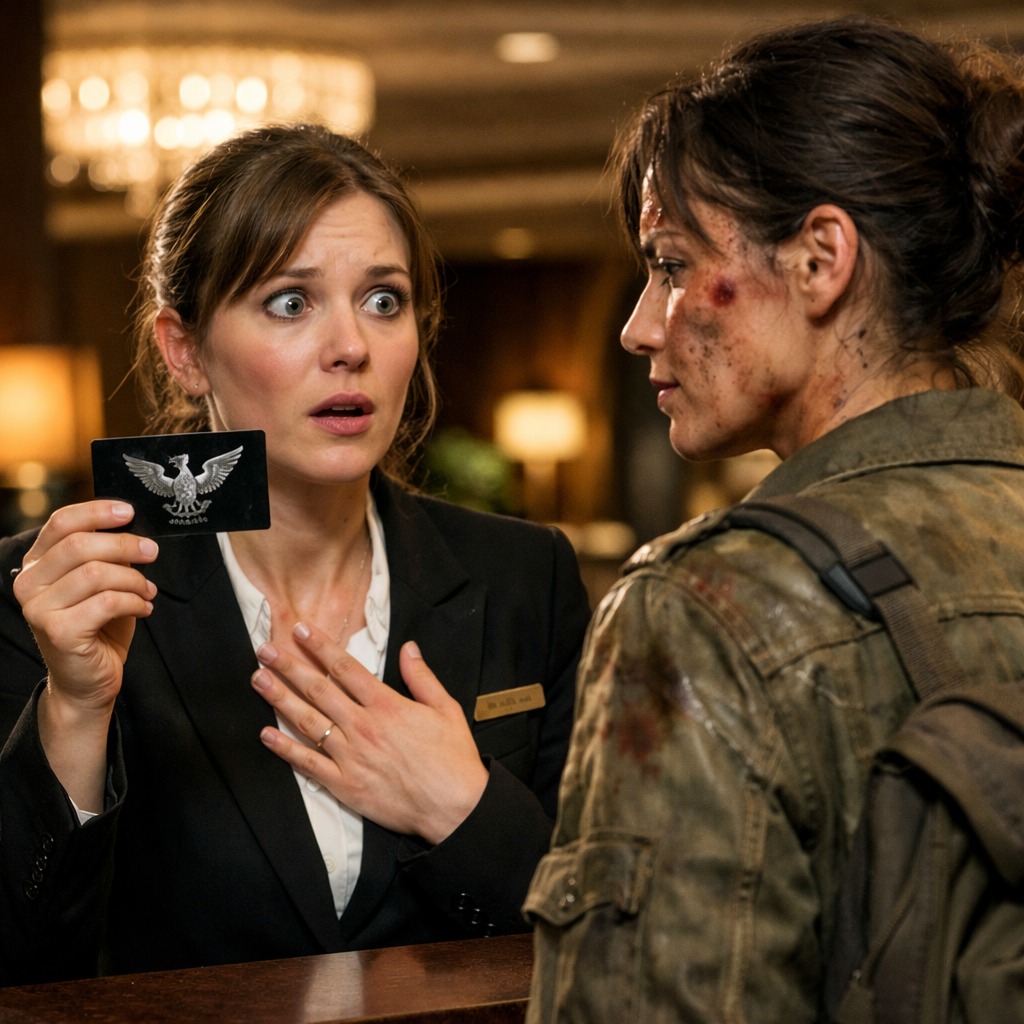
My name is Emily Carter. The night my marriage finally collapsed didn’t feel like an explosion; it felt like the quiet click of a door shutting behind me as I stood on the porch of the house I had lived in for eight years. I was holding nothing but a travel bag and a purse containing a card I had never used.
It was my father’s card.
The one he had given me a week before he died, with a cryptic warning: “Keep this safe, Em. If life turns darker than you can bear, use this. And don’t tell anyone—not even your husband.”
At the time, I thought it was just a sentimental gesture from a man who had lived a quiet life. My father, Charles Carter, had been a decorated engineer—a man of few words, a widower who never spoke much of his wealth. I assumed that when he spoke of “life turning darker,” he was just being dramatic, perhaps concerned for my happiness in a world that he knew could be unkind.
But that night, I learned that he had seen something I could not.
It had been building for months—the tension, the arguments. Ryan, my husband, had been distant for so long, and I had tried everything to salvage what was left of our relationship. But when he came home late again that evening, the faint scent of perfume lingering on his shirt, I knew. I just knew.
“Don’t start,” he muttered as he threw his keys onto the marble countertop and walked past me.
“I’m not starting anything,” I said quietly. “I’m just tired, Ryan.”
“Tired of what?” he sneered. “The life I gave you?”
His words were sharp, and for a moment, they cut through the mask of normalcy we had been wearing. He had been coming home late for weeks, smelling of a perfume that wasn’t mine. His late-night “meetings” were no longer explained away with casual lies. I knew. I just knew.
“Emily, you don’t even have a job,” he continued, his voice growing cold. “I’m working myself to the bone while you sit here, pretending everything is fine. You’ve become a burden.”
I froze. My throat felt tight. The words he was saying were the ones I had heard in my worst nightmares, but hearing them aloud, coming from him, felt like a sucker punch to my chest.
“While I what?” I whispered. “While I beg you to talk to me? While I pretend I don’t know about the woman at your office? The one who calls at midnight?”
For a brief second, his face went pale, and then something snapped inside him. He stood frozen for a moment, his eyes glazing over with a mix of anger and something else I couldn’t quite place.
“You know what? If you’re so unhappy here, leave.”
At first, I thought I had misheard him. “What?”
“I said, leave. Take your things and get out.”
I stared at him, trying to comprehend his words. “You’re kicking me out?” My voice shook with disbelief. “Because of her?”
“No,” he said flatly. “I’m kicking you out because you’ve become a burden. I’m done.”
The finality in his voice sent a chill through me. I felt like the ground had disappeared beneath my feet.
I had no time to process what was happening as he grabbed a suitcase from the closet and tossed it at my feet. “Get your stuff. I’m done.”
He didn’t look at me again. He just turned, muttering under his breath as he walked away.
I packed my things in a daze, my hands trembling as I shoved clothes into the suitcase. It felt like I was living someone else’s life. The life of a woman who had just been discarded. I left the house, stepping out into the cold Denver night.
The car I drove was my father’s old Honda, a relic of a man I didn’t fully understand. As I drove, the weight of the night hit me all at once. I couldn’t go back. I couldn’t go home. I was homeless.
I pulled the car over to the side of the road, my breath coming in ragged gasps. In the midst of everything, there was one thing that still lingered in my purse—my father’s old card.
I had kept it hidden, tucked away in the back of my wallet, ever since he died. It was the only thing he had left me, along with his final words. But I had no idea what it meant. No idea what it could do. I only knew it was meant for times like these.
I stared at the card for a long moment, its black metal surface glinting in the dim light of the dashboard. There was no logo, only an intricate engraving of an eagle wrapped around a shield. I had no idea which bank it belonged to. I didn’t know how much it was worth or what kind of account it represented. But I had no other options.
The next morning, after a restless night of tossing and turning in the car, I drove to a small inn near downtown Boulder. It was nothing fancy, but it was enough for a night’s shelter. The receptionist was a young man, disinterested in the world around him. He barely looked up as I approached.
“How many nights?” he asked.
“Just one,” I replied.
The receptionist slid the card reader toward me, indifferent as ever. My hand hovered over my purse as I fumbled with the zipper. My pulse raced in my ears. I had no idea what would happen when I used it. Would I get caught? Would it work? Or would I just look like a fool?
With a deep breath, I took out the card and inserted it.
For two long seconds, nothing happened.
Then, the receptionist’s eyes widened, his face draining of color.
“Uh… ma’am? Just a second,” he stammered.
I froze, my heart pounding in my chest. Something was wrong. But I had no idea how wrong it really was.
The receptionist didn’t speak. His fingers shook as he swiped the card again. This time, the silence that followed was more unnerving than the first. His eyes darted to the computer screen, then back at me, and I felt the atmosphere in the room shift. The small inn, once warm and comforting, now felt like a cage.
A minute passed, but it felt like an eternity. The receptionist picked up the phone, dialing a number I couldn’t hear, and muttered something under his breath.
I stood there, gripping the edge of the counter, trying to maintain my composure. But inside, my nerves were unraveling. I had no idea what I had just done—only that whatever was happening, it was bigger than I was ready for.
“Ma’am, could you please wait for a moment?” the receptionist said, his voice no longer casual but filled with a tension that I couldn’t ignore.
I nodded, not trusting myself to speak. He turned away, muttering to someone on the phone, before retreating into a back office. I was left alone, staring at the faint reflection of myself in the polished countertop. My hands were clammy, my heart still racing.
It wasn’t long before the supervisor arrived. He was an older man, likely in his mid-fifties, dressed in an ill-fitting suit. He moved swiftly, glancing at me only briefly before walking behind the counter to take the phone from the receptionist. His eyes narrowed as he studied the computer screen, a mixture of disbelief and confusion crossing his face.
“Ma’am,” he said finally, turning to face me. “I apologize for the inconvenience, but I need to ask you to follow me.”
My stomach dropped. The calmness in his voice belied the undercurrent of something much more serious. Without waiting for me to reply, he gestured for me to come along, leading me to a back room that felt far too secluded for my comfort.
As we walked, I felt the weight of the card pressing against my palm like a secret too dangerous to hold. What had I just unleashed?
The back room of the inn wasn’t what I expected. It was small and sparsely furnished, with a single desk covered in papers and a couple of chairs. The walls were adorned with old maps and photographs of the town, but the air felt sterile—unwelcoming.
“Please, take a seat,” the supervisor said, his tone suddenly more formal. “We need to discuss this matter in private.”
I hesitated but sat down. He didn’t offer any explanation, simply picking up the phone and dialing another number. The ringing sound seemed to echo in my ears as I tried to make sense of what was happening. My thoughts were a blur.
It wasn’t until the door opened again, this time with two men in suits, that I realized the situation was far beyond a simple mistake. These men weren’t here to solve a problem—they were here to manage something far more complex.
“Miss Carter,” one of the men said, his voice cool and professional. “We need to have a conversation about the card you just used.”
I looked from one man to the other, each one exuding an air of authority I couldn’t quite place. They weren’t like regular bank employees. They were too composed, too deliberate in their actions.
“Who are you?” I asked, my voice barely a whisper.
“That’s not important right now,” the other man replied. He pulled out a chair and sat down across from me, leaning forward slightly. “What’s important is that you understand what you’ve just triggered.”
I shook my head, my heart racing. “I don’t understand. It’s just a card. My father’s card.”
The man nodded slowly, as if I were a child who had just stumbled upon something far more dangerous than I could comprehend.
“Your father was a man of considerable means, Miss Carter,” he said quietly. “And the card you’ve just used belongs to a very specific kind of system. A system that operates in secrecy, far beyond the public’s reach. It’s not a card that anyone can simply swipe and walk away from.”
My head spun. I couldn’t process what he was saying. “I don’t understand. My father… he was just an engineer. He wasn’t some… some rich businessman. He wasn’t involved in anything like that.”
The man’s expression softened, but his eyes were unwavering. “Your father’s work, Miss Carter, went far beyond what you were told. Far beyond what anyone was told. This card represents access to a financial system designed to protect certain interests—interests far more valuable than anything you or your father could have imagined.”
I sat there in stunned silence, the weight of his words sinking in like lead. My father—a quiet, unassuming man—had been part of something so secretive, so powerful, that I had no idea it even existed. It didn’t seem possible.
“What do you mean?” I managed to ask, my voice cracking.
“You see,” the man continued, “this card is not tied to any traditional banking system. It’s part of a network used by governments, corporations, and other highly influential entities to manage assets that the public would never know about. What’s more, it’s not just about money. It’s about power—resources, strategies, operations that shape the course of history without anyone even realizing it.”
I swallowed hard, my throat dry. “What does this have to do with me?”
“Your father was a key figure in this system,” the man said. “He was part of a group that made decisions in the shadows. And now, that group is aware that the card has been used.”
I stood up abruptly, my mind reeling. “What do you mean ‘aware’? Who are these people?”
The man stood as well, his voice calm but firm. “These are people who operate beyond the law, Miss Carter. People who protect systems and resources that the world depends on without ever acknowledging their existence. You’ve opened a door that you might never be able to close.”
A chill ran down my spine as his words sank in. This was no longer just about a simple card or a broken marriage. It was about something far larger than I had ever imagined—something that I had just become an unwilling part of.
Before I could process any further, the door opened again, and a new figure entered. This time, it wasn’t just anyone. The man who walked in was older, his face weathered but sharp, and there was something distinctly unsettling about the way he carried himself. His presence filled the room like an ominous storm.
“You’ve made a mistake, Emily,” he said with a cold smile. “And now you need to understand just how deep that mistake runs.”
The man who had just entered the room surveyed me with a cold, calculating gaze, as though I were some puzzle he was about to solve. His expression betrayed nothing—no empathy, no warmth. Only the sharpness of someone who had seen far too much to be surprised by anything anymore.
He was older than the others, perhaps in his sixties, with a face that spoke of experience in places I couldn’t begin to understand. His hair was mostly gray, but his eyes—they were sharp, piercing. He moved like a predator, every step deliberate, confident, as if he was completely in control of everything.
“Miss Carter,” he began, his voice calm, yet carrying an edge that made me uneasy. “My name is Philip Armitage. I’m with the organization that your father was involved with. The system, as we’ve been calling it.”
I swallowed, feeling a sense of dread build up in the pit of my stomach. I had thought the situation was bad before, but now it was becoming clear that this was something far beyond anything I could’ve imagined.
“I’m afraid you’ve made a grave mistake, using that card,” Armitage continued. “That card is not just a piece of plastic. It’s a key—a key to a financial and logistical system that operates outside the traditional structures. And when you used it, you triggered an alarm.”
An alarm? My mind raced. I had no idea what I had just done, but it was clear now that I had stepped into a world I didn’t belong in.
“I didn’t know. I had no idea about any of this,” I whispered, my voice barely audible. I wanted to explain that I wasn’t some spy or opportunist—I had just been desperate. But there was no use. The truth was, I didn’t know what I was a part of now.
“I understand that you didn’t know,” Armitage said, his tone softening just a fraction, though his eyes remained as cold as before. “But your ignorance doesn’t change the fact that you’ve stumbled into something far bigger than you are, or that your father ever told you.”
I could feel the weight of his words crushing me. My father, the man I had thought I knew, had been involved in something so vast, so secretive, that even now, with all these people around me, I still couldn’t grasp its scope.
“You see, your father wasn’t just an engineer. He was part of a group—an elite group—that managed certain assets and resources, things that can’t be traced back to any government or public entity,” Armitage explained. “These resources are critical to the global balance of power. And they’re not just money or wealth, but things much more dangerous.”
The words felt like they were coming at me from all directions, too fast to fully comprehend. I wanted to ask more questions, to demand answers, but I couldn’t find my voice. What had my father really been involved in? And why had he kept it a secret from me?
I looked around the room, trying to make sense of the people here. The supervisor, the receptionist—they were just cogs in this larger system, mere players in a game I didn’t understand. But Armitage… he was different. He was the puppet master, the one pulling the strings.
“What does this have to do with me?” I asked, finally finding my voice. “What do you want from me?”
Armitage didn’t answer immediately. He glanced at the other men in the room before turning his gaze back to me.
“We don’t want anything from you, Miss Carter,” he said slowly. “But the fact is, the card you used is more than just a simple access tool. It represents a commitment to a system that no one can simply opt out of. You’re now involved in something that has been carefully orchestrated for decades, and it’s too late to walk away.”
I felt a cold sweat break out across my skin. It wasn’t just about the card anymore—it was about everything that came with it. The system, the resources, the power.
“You’re saying I can’t leave,” I said, my voice trembling.
Armitage nodded. “Exactly. Your father’s involvement wasn’t voluntary for him, and it won’t be for you either. You’ve opened a door, and once it’s opened, there’s no going back. You’ve become a part of this system, whether you like it or not.”
The room felt smaller suddenly, suffocating. I leaned back in my chair, trying to process what was happening. My father, the man I had loved and respected, had been part of something so secretive, so dangerous, that it made my head spin.
Armitage leaned forward, his voice dropping to a low, almost conspiratorial whisper. “And now, we need to make sure that the system doesn’t notice you. We need to keep you under the radar until we can figure out how to control the damage.”
“Control the damage?” I repeated, my mind reeling. “What damage? What are you talking about?”
He raised a hand, cutting me off. “You’ve exposed the existence of this system. You’ve given it visibility. That means others will come looking. Some will want to use it for their own benefit. Others will want to destroy it. We can’t allow that.”
“You’re saying there are others?” I asked, my stomach tightening with fear.
Armitage’s lips twitched into a small, humorless smile. “Of course. There are always others. Always those who want power. And now that you’ve used the card, you’ve become a target.”
The weight of his words settled over me like a heavy fog. I had no idea what kind of forces I had just become entangled with, but it was clear now that I was in over my head. My father’s death, my husband’s betrayal—those were just the beginning. Now, I was caught in something much bigger, something that could destroy me before I even knew what hit me.
The door opened again, this time to reveal a young woman in a crisp suit. Her eyes were sharp, her expression unreadable. She walked into the room with the kind of authority that made everyone else stand just a little straighter.
“Mr. Armitage,” she said, her voice clipped. “We need to move her. Now.”
Armitage didn’t hesitate. He stood up, his face suddenly dark. “You’re right. We don’t have time to waste.”
He turned to me. “Miss Carter, I’m afraid you’ll have to come with us. You’ll be safer under our protection, at least for the time being.”
Before I could speak, the woman stepped forward, holding out a folder. “Everything you need to know is here,” she said. “Your next steps. But we need to move quickly. We can’t afford to be seen.”
I stared at the folder in her hand, my mind swirling. This was real. This wasn’t just some bad dream. I had no choice now.
I stared at the folder in the woman’s hands, the edges of the paper sharp against her fingers, as if it were the key to a new world that I had no business entering. My heart hammered in my chest. The words “safer under our protection” hung in the air, suffocating me. Protection from what? And who were these people really?
But as I looked around the room, seeing the men in suits who had been watching me, I realized that I had no choice. This wasn’t something I could walk away from. I had stepped too far into the shadows, and now they were closing in around me.
The woman handed me the folder without a word, and I took it hesitantly. It felt heavier than it should have, as though it contained more than just paper. Inside, I found a series of documents: a brief history of my father’s work, a set of instructions on how to proceed, and several names—names that seemed unimportant but sent a chill through me nonetheless.
“Come on,” the woman said, her voice cold, as if all of this was routine. “We need to move. They’ll be here soon.”
I wanted to ask more questions, to demand answers about what was happening, but I didn’t dare. It was clear that my confusion was only making me more vulnerable. I stood up, clutching the folder to my chest, my mind racing with the overwhelming weight of the situation.
We walked out of the room, down a narrow hallway, and into a back entrance of the inn. The air outside was crisp, the evening sky painted with the colors of twilight. A black SUV was parked just outside, its engine already running. The woman gestured toward the vehicle, and without another word, I climbed in.