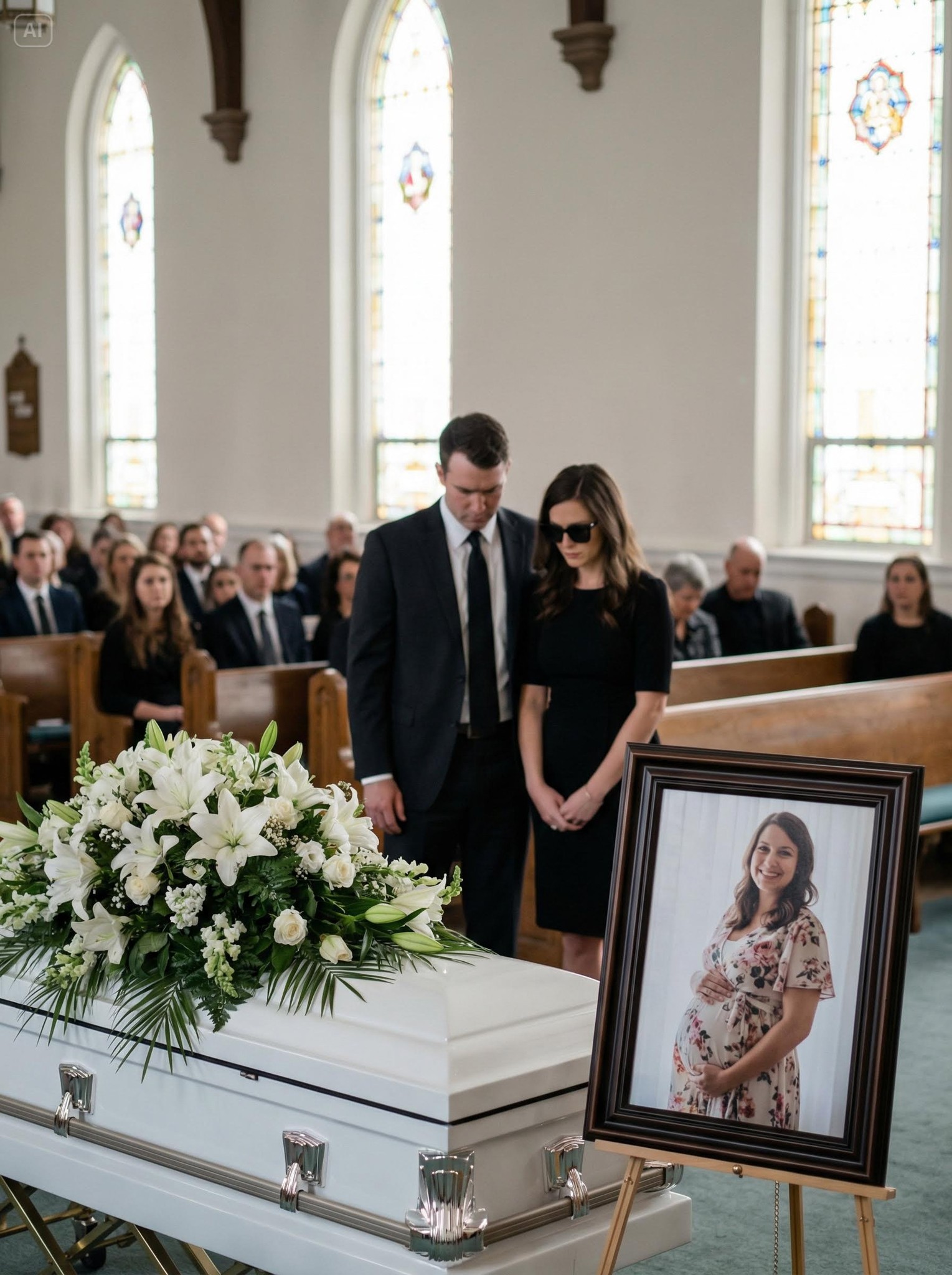
I will never forget the sound of the church doors opening.
Not because it was loud. It wasn’t. It was the soft, hollow groan of old wood moving against old hinges—polite, almost respectful. But inside that small Texas church, where white lilies crowded the air and grief sat in the pews like a second congregation, that sound landed like a slap.
Because everyone turned.
And Jason Reed walked in like the day belonged to him.
Black suit. Clean haircut. Face arranged into the kind of solemn expression men practice in mirrors when they know people are watching. He moved down the aisle at an unhurried pace, as if he had all the time in the world.
And on his arm—clinging to him like she had earned the right—was a tall brunette in a tight black dress.
Rachel.
The coworker.

The name my sister Lily had tried not to say out loud for months, as if naming her made her real.
My mother’s breath caught so sharply I felt it in my bones.
“Is he serious?” she whispered, clutching my hand so hard it hurt.
I stared at them, my mind refusing to cooperate at first, like this was too cruel to be true.
“That’s Rachel,” I muttered. My throat felt dry. “That’s… her.”
People stared. Whispers jumped like sparks through dry grass. Phones didn’t come up yet—this was still a funeral, still a place where shame had to pretend to be manners—but I saw faces turning, mouths tightening, eyes narrowing.
Jason didn’t flinch.
He guided Rachel to the front row.
Lily’s row.
The row where my sister should have been sitting, laughing softly at my dad’s jokes, rubbing her swollen belly, telling us she was tired but happy because the baby was finally kicking hard enough to feel like a person.
But Lily wasn’t there.
Lily was in the closed casket at the front of the church.
Thirty-two weeks pregnant when she “fell” down the stairs.
That’s what Jason told everyone.
An accident. Tragic. Unavoidable.
I hadn’t believed him for a second.
I rose halfway from my seat on instinct, anger cutting through grief like a blade.
I wanted to walk down that aisle, grab Rachel by the wrist, and drag her out of the church so hard her heels snapped. I wanted to make Jason look at the front of the sanctuary—at the flowers, the casket, the quiet—and understand what kind of monster you have to be to bring your affair partner to the funeral of the woman you betrayed.
My father’s hand clamped on my arm.
“Not here, Em,” he hissed, eyes bright with warning. “Not during the service.”
My father’s voice wasn’t soft, but it was controlled. That’s who he was—control even when his heart was shredding. He didn’t want violence in the same room where our daughter lay dead. He didn’t want Jason to become the story.
But Jason had already made himself the story, and he knew it.
Rachel leaned her head on his shoulder like she was the grieving widow. Like she belonged in Lily’s place.
My blood went hot. My vision tunneled. I stared at Jason’s profile—how calm he looked. How comfortable. And I thought, How can a man sit there pretending to mourn when he’s already moved someone else into her seat?
The pastor started speaking about Lily. About her kindness. Her laugh. Her stubborn streak. About the baby boy she’d already named Noah—because she loved that name, because she said it sounded like hope.
People dabbed their eyes. People sniffled. The hymns came, soft and familiar, and all the while Jason sat there with Rachel’s hand in his, acting like grief was something he could borrow when it made him look respectable.
I tried to focus on the casket. Tried to picture Lily as she was before the stairs, before the bruises no one could explain, before she started looking over her shoulder in her own kitchen.
But my eyes kept drifting to Jason and Rachel.
Because something about the way she clung to him felt rehearsed.
Not comfort.
Possession.
And then the service ended.
The final hymn faded. The pastor gave a quiet blessing. People began to stand, the slow shuffle of grief moving toward the exit.
That’s when the man in the gray suit stepped forward.
He was late fifties, calm eyes, leather briefcase in hand. Not dressed like a mourner. Dressed like someone who had come to deliver something precise.
“Excuse me,” he said, and his voice echoed through the quiet church. “My name is Daniel Hayes. I’m Lily Reed’s attorney.”
Jason’s head snapped up so fast it looked like a reflex.
“Now?” he snapped. “We’re doing this now?”
Mr. Hayes didn’t flinch. Didn’t soften. Didn’t apologize for interrupting grief.
“Your wife left very specific instructions,” he said evenly. “Her will is to be opened and read today. In front of her family.”
He paused.
“And in front of you.”
The room tightened. You could feel it—the church air shifting from sorrow to something sharper.
Mr. Hayes opened his file slowly, as if he was giving the room time to choose what it wanted to be: a funeral, or a reckoning.
“There is a section,” he said, “that Lily insisted be read aloud at her funeral.”
Rachel’s grip on Jason’s arm tightened.
Jason’s face went pale in a way that didn’t match grief.
Mr. Hayes unfolded a single sheet of paper. The edges were worn like it had been handled too many times. Like Lily had read it over and over, deciding if she was brave enough to write it.
“This is a personal statement attached to her will,” Mr. Hayes said. “Written in her own hand. Dated three weeks before her death.”
Every eye in the room turned.
And he began to read.
“If you are hearing this, it means I’m gone. Jason, I know about Rachel. I’ve known for longer than you think.”
A gasp rippled across the pews.
My mother covered her mouth.
Jason went rigid, jaw clenched so hard I saw the muscle jump.
“I tried to forgive you, for our baby’s sake,” the letter continued, “but every time you came home late, every time you lied to my face, a part of me died before my body ever did. So I changed my will.”
Jason shot to his feet.
“This is bullshit,” he barked. “She didn’t write that.”
Rachel tugged on his sleeve, voice low and frantic. “Jason, sit down.”
Phones started to lift now. Quietly. Discreetly. Like people sensed history being made and didn’t want to be the only ones without proof.
Mr. Hayes didn’t raise his voice. He didn’t need to.
“To my husband, Jason Reed,” he read, “I leave nothing beyond what is legally required. You may keep your personal belongings and the car already in your name. That is all. You’ve taken enough from me.”
The church was so silent I could hear someone’s bracelet clink when they shifted.
Jason’s face twisted with rage, but something else was underneath it—panic.
Mr. Hayes continued.
“My estate, including the house, savings, and life insurance benefits, are to be placed in a trust for our unborn son, Noah. If Noah does not survive… the trust passes to my sister, Emily Carter, who will decide how to honor my memory.”
My knees nearly buckled.
I hadn’t known.
Lily hadn’t told me. Maybe she’d been afraid I’d confront Jason too soon. Maybe she knew the moment I knew, I wouldn’t be able to pretend anymore.
Jason laughed bitterly, grasping for power.
“Your ‘trust’?” he sneered. “Emily can’t even pay her own rent. This is insane.”
Mr. Hayes’ tone sharpened.
“Sit down, Mr. Reed. There’s more.”
He reached into his briefcase and pulled out a thick sealed envelope.
“This,” he said, holding it up, “was delivered to my office two days before Lily’s accident. It is labeled, in her handwriting: ‘To be opened only if my death is ruled or treated as an accident.’”
The room went cold.
Jason’s face drained of color so fast it looked like someone had unplugged him.
Mr. Hayes broke the seal.
“If Jason says I fell, please don’t just believe him,” he read. “On March 5th, after I confronted him about Rachel, he grabbed my arm so hard it bruised. He told me, ‘If you ruin my life, I’ll ruin yours.’ I started to feel unsafe in my own home.”
My stomach twisted.
Mr. Hayes reached into the briefcase again and placed a small black flash drive on the lectern like it weighed a hundred pounds.
“I installed a small security camera at the top of the staircase,” Lily’s letter said. “If anything happens to me, my lawyer has instructions.”
Jason stared at the drive like it was a live bomb.
Mr. Hayes looked straight at him.
“She wanted her voice heard,” he said quietly. “And now it will be.”
Two weeks later, I sat in a cramped room at the police station, staring at a laptop screen with a detective, Mr. Hayes, and my parents.
The video was grainy but clear enough.
Lily stood at the top of the stairs, eight months pregnant, tear-streaked, clutching her phone like it was the only thing holding her upright.
Jason stood at the bottom, yelling, his voice unmistakable.
“You’re not leaving!” he shouted. “You’re not taking my son!”
“He’s not a trophy!” Lily cried. “I’m done, Jason. I’ll take Noah and go to my parents’—”
Jason charged up the stairs.
Grabbed her wrist.
She tried to pull away.
His arm swung.
Her foot slipped.
We watched my sister fall.
My mother made a sound I never want to hear again—something between a sob and a scream, like her body couldn’t decide how to survive what her eyes were seeing.
My father put his arm around her and held her like he could keep her from breaking apart.
I couldn’t breathe.
The detective paused the video and stared at the screen for a long moment.
“She hit her head,” he said quietly. “And given this letter… this isn’t an accident. This is a case.”
Within days, Jason was arrested. Manslaughter. Domestic violence. Obstruction.
The newspapers called it “the staircase tragedy,” like it was a movie instead of a woman being pushed out of her life.
Rachel vanished from social media overnight, as if deleting accounts could erase fingerprints.
At the arraignment, Jason shuffled in wearing an orange jumpsuit and shackles. For the first time, he didn’t look polished. He looked small.
As he passed me, he hissed under his breath, “Emily, tell them… tell them I didn’t mean—”
I stood up, voice shaking with fury.
“You brought your mistress to my sister’s funeral,” I said coldly. “You meant every second of this.”
He looked away.
The trust was finalized months later.
Noah didn’t survive. Lily’s baby boy, named for hope, never got to breathe.
So everything passed to me, just like Lily wrote.
I didn’t feel lucky.
I felt heavy.
Like every dollar was soaked in the price she’d paid.
I moved into Lily’s house—not because I wanted it, but because I couldn’t bear to let it sit empty like a monument to what he tried to erase. I painted over the scuffed wall by the stairs. I installed brighter lights. I changed the locks twice.
And I turned the nursery that never got used into something Lily would have understood immediately: a small space where women could come for support. Legal resources. A meal. A safe chair. A place where someone believed them the first time.
Sometimes, late at night, I sit at the kitchen table with Lily’s letter in front of me.
I trace her handwriting with my finger and realize what she really did.
She wasn’t just writing a will.
She was building an escape plan.
She was leaving a map for the people who loved her, so we wouldn’t have to guess.
So we wouldn’t have to doubt ourselves the way she’d been forced to doubt her own reality.
And every time I think about Jason walking into that church with Rachel on his arm, acting like Lily’s death was his stage…
…I remember the moment the room changed.
Not when he arrived.
When Lily’s words were read aloud.
Because that was the day he learned what Lily already knew:
If you can’t get out alive, you leave evidence so the truth can still walk.